
Drone Laws in New York
Your complete 2026 guide to flying drones legally in New York.
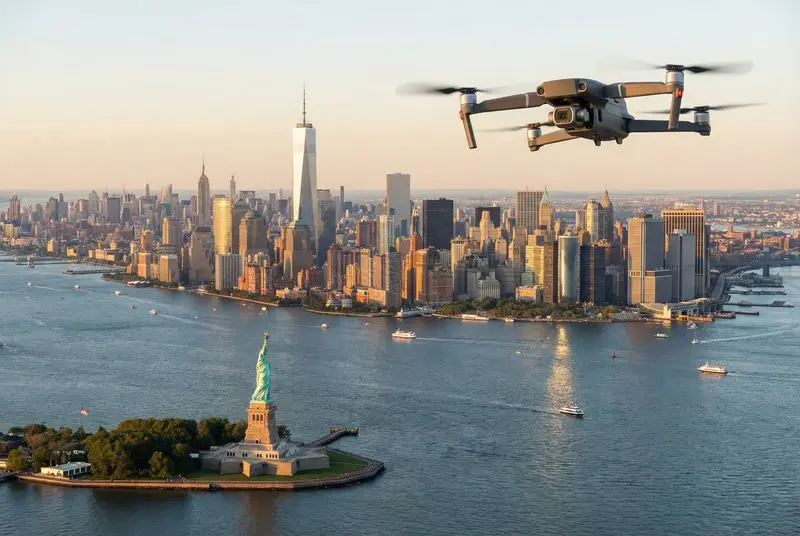
Drone Laws in New York: What You Need to Know (2026 Guide)
The primary keyword, “drone laws in New York,” reflects the core of this guide. We will cover the foundational federal regulations from the FAA that apply nationwide, explore the specific rules for New York’s state-managed lands, and untangle the highly restrictive permitting process in New York City. Understanding these different layers of legislation is crucial for any drone pilot in the state.
Federal Drone Laws That Apply in New York
Before diving into state-specific rules, all drone pilots in New York must adhere to the regulations set by the Federal Aviation Administration (FAA). These laws form the basis of safe drone operation across the United States.
- Registration: All drones weighing more than 0.55 pounds (250 grams) must be registered with the FAA. The registration costs $5 and is valid for three years. The registration number must be marked on the exterior of the drone.
- Remote ID: As of September 16, 2023, all registered drones must broadcast Remote ID information, which acts as a digital license plate. The only exception is for drones flown within an FAA-Recognized Identification Area (FRIA).
- Recreational Flyers (Section 44809): Hobbyist pilots must take The Recreational UAS Safety Test (TRUST) and carry proof of completion. They must also follow the safety guidelines of a Community-Based Organization (CBO), fly at or below 400 feet in uncontrolled airspace (Class G), and obtain authorization through LAANC to fly in controlled airspace.
- Commercial Operators (Part 107): Anyone flying a drone for business or non-recreational purposes must obtain a Remote Pilot Certificate by passing the FAA’s Part 107 knowledge test. This certificate is required for any flight that is not strictly for personal enjoyment.
- General Flight Rules: All pilots must keep their drone within their visual line of sight (VLOS), give way to manned aircraft, and never operate a drone in a reckless manner. Flying at night is permitted but requires anti-collision lighting.
For registration and more detailed information, pilots should visit the official FAA DroneZone and use the B4UFLY app to check airspace before every flight.
New York State-Specific Drone Laws
While New York State has not enacted a single, comprehensive state-wide law governing all drone use, several key regulations exist within state agency rules and proposed legislation that pilots must be aware of. These rules primarily address drone operations on state-managed lands and for specific activities like hunting.
Drone Use on State Lands (DEC Regulations)
The New York State Department of Environmental Conservation (DEC) has established specific policies for drone use on the lands and waters it manages. These rules, outlined in Commissioner’s Policy 71 (CP-71) and various land use regulations, create a patchwork of permissions and prohibitions depending on the land classification [1].
Key provisions include:
- Prohibited Areas: The operation of drones is strictly prohibited in areas classified as Wilderness, Primitive, Primitive Bicycle Corridors, and Canoe Areas within the vast Adirondack and Catskill Forest Preserves. This is based on the regulation prohibiting motorized equipment in these sensitive ecological zones (6 NYCRR 196.8).
- Permitted Use with Restrictions: In other areas, such as Wild Forest lands within the Forest Preserves, and on State Forests, Multiple Use Areas, and Unique Areas, recreational drone use is generally permitted. However, commercial drone operations in these locations require a Temporary Revocable Permit (TRP) from the DEC.
- Special Contact Required: For drone flights within Wildlife Management Areas (WMAs) or certain Unique and Multiple Use Areas, both recreational and commercial pilots are instructed to contact the nearest regional DEC Wildlife office before flying.
- Environmental Education Centers & Camps: Drone use is forbidden at the state’s four Environmental Education Centers and four residential youth camps, except for specific research or training purposes authorized by a TRP.
Hunting and Wildlife Regulations
New York law addresses the use of drones in activities related to hunting and wildlife. The Environmental Conservation Law (ECL) has a broad definition of “taking” wildlife, which includes acts of “disturbing, harrying or worrying” [2]. Flying a drone too close to wildlife could be interpreted as a violation of this statute.
Furthermore, a bill currently in the New York State Senate (S3542, 2025-2026 session) seeks to clarify the rules around drones and hunting. If passed, the bill would explicitly prohibit using a drone to “search for, scout, locate, hunt, detect, or otherwise aid in the taking of a wild animal.” However, the bill includes a notable exception that would permit the use of a drone, even one with infrared capabilities, to help locate and recover a legally shot animal, provided the drone operator has permission to be on the property [3].
Local and City Drone Regulations in New York
Local drone ordinances in New York are most prominent in New York City, which has established its own comprehensive permitting system. Pilots must be aware that the state does not have a broad preemption law, meaning other municipalities could enact their own local drone rules.
New York City Drone Rules
Flying a drone in New York City is highly restricted and requires explicit permission from the New York City Police Department (NYPD). The rules, established in partnership with the Department of Transportation (DOT), are based on NYC Administrative Code § 10-126(c), which has long prohibited the takeoff and landing of aircraft in the city.
As of July 2023, the city has a formal permit system in place (38 RCNY § 24). Key aspects of the law include:
- Permit Required: A permit issued by the NYPD is required for any drone takeoff or landing within the five boroughs of New York City [4].
- Application Process: Pilots must apply for a permit through an online portal, and the NYPD and DOT review each application.
- Exceptions: The primary exception to the permit requirement is for flights conducted entirely within designated Model Aircraft Fields managed by the NYC Department of Parks & Recreation.
- Notification Requirements: If a permitted flight involves capturing images or video, the operator is required to notify the local community board and post notices near the takeoff and landing zones.
Due to the complexity and density of the airspace and environment, flying a drone in New York City without a permit is illegal and can result in significant penalties. It is one of the most restrictive urban environments for drone operations in the United States.
Where You Can and Can’t Fly in New York
Navigating the skies of New York requires an understanding of where you are legally allowed to operate your drone. Beyond the federal, state, and local laws, many areas are off-limits due to their sensitive nature or for safety reasons.
General No-Fly Zones
- National Parks: The National Park Service (NPS) has banned drone operations in all areas it administers nationwide, including sites in New York like the Statue of Liberty National Monument and Saratoga National Historical Park.
- State Parks: Drone use is generally prohibited in New York State Parks and Historic Sites, which are managed by the NYS Office of Parks, Recreation, and Historic Preservation (OPRHP). A written permit may be available in some cases, but recreational flights are typically not allowed.
- Near Airports: It is illegal to fly in controlled airspace (Class B, C, D, and E) near airports without prior authorization. In New York, this includes the busy airspace around JFK, LaGuardia, and Newark (part of the NYC Class B), as well as numerous other airports. Authorization must be obtained through the FAA’s LAANC system.
- Near Military Installations: Flying near military bases is restricted. New York has several installations, such as Fort Drum and the West Point Military Academy, where drone flights are prohibited.
- Over Stadiums and Sporting Events: The FAA implements Temporary Flight Restrictions (TFRs) over stadiums during major sporting events. This includes venues like Yankee Stadium, Citi Field, and Highmark Stadium during games.
Popular Flying Locations
While many areas are restricted, there are still places where you can fly your drone in New York, particularly in less populated areas and on private property (with permission). Always use the FAA’s B4UFLY app to check for airspace restrictions before every flight. Some AMA-affiliated clubs also maintain designated flying fields for members.
Penalties and Enforcement
Violating drone laws in New York can lead to serious consequences from federal, state, and local authorities.
- Federal Penalties: The FAA has the authority to issue significant fines for violations of its regulations. These can range from $1,771 for minor infractions to over $36,770 per violation for more serious offenses, such as flying in a TFR or endangering other aircraft.
- State Penalties: Violating DEC regulations on state land can result in fines and other penalties under the Environmental Conservation Law. For example, illegally disturbing wildlife with a drone could be considered an illegal “take.”
- Local Penalties: In New York City, operating a drone without a permit is a misdemeanor, which can lead to fines, equipment confiscation, and even jail time.
Tips for Staying Compliant
Staying on the right side of the law is crucial for every drone pilot. Here are some essential tips for flying in New York:
- Check B4UFLY Before Every Flight: This is the most critical step. The FAA’s B4UFLY app provides up-to-date airspace information, including airport restrictions, TFRs, and other advisories.
- Register Your Drone: If your drone weighs 0.55 lbs (250 grams) or more, it must be registered with the FAA. The registration number must be visible on the exterior of the aircraft.
- Get Certified: All recreational pilots must pass The Recreational UAS Safety Test (TRUST) and carry proof of passing. Commercial pilots must obtain a Part 107 Remote Pilot Certificate from the FAA.
- Respect Privacy: Do not fly over private property without permission, and avoid capturing images or video of people without their consent. This is especially important in residential areas.
- Check Local and State Land Rules: Before flying on any public land, verify the specific rules for that location. Check the websites for the DEC, NYS Parks (OPRHP), and any local city or county parks department.
- Maintain Visual Line of Sight (VLOS): You must be able to see your drone with your own eyes at all times. Do not fly beyond this range.
Helpful Resources
- FAA DroneZone: The official portal for registering your drone and obtaining Part 107 certification. https://faadronezone.faa.gov
- B4UFLY App: Essential for checking airspace restrictions before you fly. https://www.faa.gov/uas/getting_started/b4ufly
- NYS DEC Drone Page: Provides information on drone use on DEC-managed lands. https://dec.ny.gov/regulatory/guidance-and-policy-documents/drone-use-on-dec-managed-lands
- NYC Drone Permit Portal: The official site for applying for a drone permit in New York City. https://www.nyc.gov/site/nypd/services/law-enforcement/permits-uas-permits.page
- Drone Launch Academy Part 107 Course: A comprehensive course to help you pass the FAA Part 107 exam. https://dronelaunchacademy.com/drone-exam-study-course/
Internal Links:
- Return to the main Drone Laws by State Directory.
- Learn about drone laws in neighboring states: New Jersey and Connecticut.
References
[1] NYS Department of Environmental Conservation, “Drone Use On DEC Managed Lands,” https://dec.ny.gov/regulatory/guidance-and-policy-documents/drone-use-on-dec-managed-lands
[2] New York Consolidated Laws, Environmental Conservation Law – ECL § 11-0103, https://www.nysenate.gov/legislation/laws/ENV/11-0103
[3] NY State Senate Bill S3542 (2025-2026), https://www.nysenate.gov/legislation/bills/2025/S3542
[4] City of New York, “Unmanned Aircraft (UA) Permits,” https://www.nyc.gov/site/nypd/services/law-enforcement/permits-uas-permits.page
← Back to Drone Laws by State Directory
Disclaimer: Drone laws are constantly evolving. While we strive to keep this guide updated, you should always verify local ordinances and check the FAA B4UFLY app before flying. This page is for educational purposes and does not constitute legal advice.
Sources: FAA UAS | NCSL State Drone Law Landscape | FAA Remote ID | FAA Part 107