
Drone Laws in Georgia
Your complete 2026 guide to flying drones legally in Georgia.
Navigating the skies with a drone in Georgia requires a clear understanding of the rules.This guide provides an overview of everything you need to know to operate your drone responsibly in Georgia.
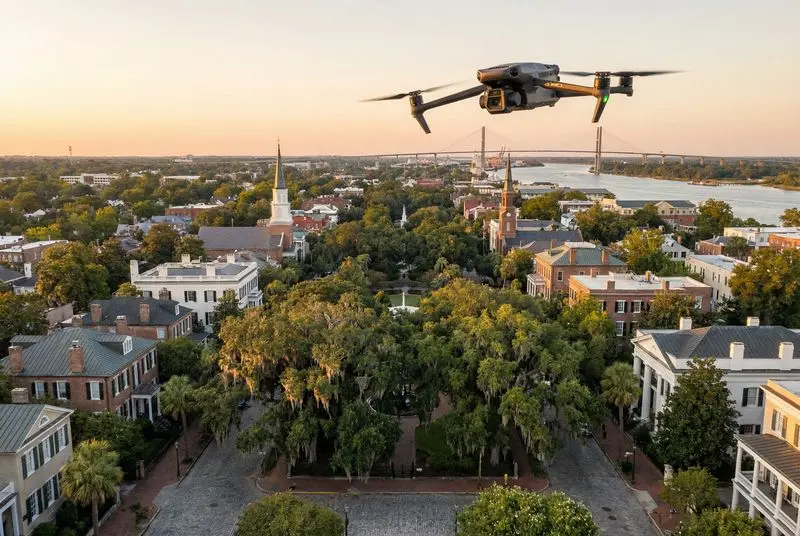
From the bustling city of Atlanta to the serene Blue Ridge Mountains, Georgia offers a diverse range of locations for drone enthusiasts. However, with this variety comes a layered legal landscape.We will also explore local ordinances in various cities and counties, helping you stay compliant no matter where you fly.
Federal Drone Laws That Apply in Georgia
All drone pilots operating in Georgia must adhere to the regulations set forth by the FAA. These rules form the foundation of drone safety and are enforced across the United States. They cover aspects like drone registration, pilot certification, and operational limitations to ensure that the national airspace remains safe for everyone.
For commercial drone pilots, the primary regulation is the FAA’s Part 107, which requires pilots to obtain a Remote Pilot Certificate. Recreational flyers, on the other hand, must pass The Recreational UAS Safety Test (TRUST) and follow a distinct set of community-based safety guidelines. A key requirement for all drones weighing more than 0.55 pounds (250 grams) is registration with the FAA. Furthermore, as of September 16, 2023, most drones are required to broadcast Remote ID information, acting as a digital license plate.
Here are the core federal drone regulations to be aware of:
- Registration: Drones weighing over 0.55 lbs must be registered on the FAA DroneZone website.
- Remote ID: Most registered drones must be capable of broadcasting Remote ID signals.
- Part 107 Certification: Commercial pilots must pass the Part 107 exam and obtain a Remote Pilot Certificate.
- TRUST Certification: Recreational pilots must pass The Recreational UAS Safety Test (TRUST).
- Altitude Limit: Drones must not be flown higher than 400 feet above ground level.
- Visual Line of Sight (VLOS): Pilots must keep their drones within their visual line of sight at all times.
- Airspace Authorization: Flights in controlled airspace (Class B, C, D, and E) require authorization, typically obtained through LAANC.
- B4UFLY App: The FAA recommends using the B4UFLY app to check for airspace restrictions before every flight.
Georgia-Specific Drone Laws
Georgia has taken a clear stance on drone regulation by enacting a statewide law that preempts most local ordinances. This provides a more consistent legal framework for drone pilots across the state. The primary piece of legislation governing drone use in Georgia is House Bill 481 (HB 481), which was signed into law in 2017. This law is codified in the Official Code of Georgia Annotated (O.C.G.A.) § 6-1-4.
Here are the key provisions of Georgia’s state drone law:
-
State Preemption: HB 481 establishes that the state government has the sole authority to regulate drone operations. This means that counties, municipalities, and other political subdivisions are generally prohibited from creating their own drone laws or ordinances. This preemption ensures a uniform set of rules for drone pilots throughout Georgia.
-
Exception for Local Governments: While local governments cannot regulate the “testing or operation” of drones, they are permitted to adopt ordinances that prohibit the launching or intentional landing of unmanned aircraft from public property. This allows local authorities to manage drone activity in parks, government building premises, and other public areas.
-
Prohibition on Photographing Prisons: Georgia law (O.C.G.A. § 42-5-18) makes it illegal to use a drone to photograph or record images of a place of incarceration without the written consent of the person in charge of the facility.
Local and City Regulations
While Georgia’s state law provides a baseline for drone regulations, some local governments have enacted ordinances within the scope of their authority, primarily concerning the takeoff and landing of drones on public property. It is important for drone pilots to be aware of these local rules before flying in a specific area.
Here are some examples of local drone regulations in Georgia:
-
Richmond County: In Richmond County, which includes the city of Augusta, an ordinance (No. 7531) restricts the use of drones in highly populated areas. Launching or operating a drone in an area with a seating capacity of 100 or more people, or at an open-air assembly of 100 or more people, requires written authorization from the Richmond County Sheriff. The ordinance also makes it unlawful to use a drone to capture an image of privately owned property without the express consent of the owner or occupant.
-
Cherokee County: Cherokee County has an ordinance (Code of Ordinances, Sec. 42-55) that makes it unlawful to launch or land any unmanned aerial system in all county public parks and recreation areas, except in areas specifically designated for that purpose.
-
City of Conyers: The City of Conyers has a specific regulation (Code of Ordinances, Sec. 11-1-2) that prohibits the launching or landing of drones within the boundaries of the Georgia International Horse Park.
Where You Can and Can’t Fly in Georgia
Understanding where you are allowed to fly your drone is just as important as knowing the rules of operation. In Georgia, the airspace is a mix of open areas, controlled zones, and restricted locations. Awareness of these areas is key to a successful and lawful flight.
Here’s a breakdown of the key locations and their associated drone regulations:
-
State Parks and Historic Sites: As a general rule, operating a drone in Georgia’s State Parks and Historic Sites is prohibited. However, waivers may be granted for professional, commercial projects that could help promote the sites or generate revenue. These waivers require approval from the Division Director.
-
National Parks: The National Park Service has banned the use of drones in all national parks, and this includes those within Georgia, such as the Chattahoochee River National Recreation Area and the Chickamauga & Chattanooga National Military Park.
-
Near Airports: Flying a drone near an airport is subject to strict regulations. The airspace around airports is typically controlled, and pilots must obtain authorization through the FAA’s LAANC system before flying. The B4UFLY app is an essential tool for identifying these areas.
-
Military Installations: Georgia is home to several military bases, including Fort Benning, Robins Air Force Base, and Fort Stewart. Flying a drone near these installations is restricted, and pilots should maintain a safe distance to avoid interfering with military operations.
-
Stadiums and Sporting Events: The FAA implements Temporary Flight Restrictions (TFRs) over stadiums and sporting events. It is illegal to fly a drone within a three-mile radius of a stadium with a seating capacity of 30,000 or more during a major sporting event.
Penalties and Enforcement
Violating federal, state, or local drone laws in Georgia can result in significant penalties. Both the FAA and state authorities have the power to enforce these regulations, and the consequences can range from civil fines to criminal charges, depending on the severity of the offense.
Here’s what you need to know about the potential penalties:
-
Federal Penalties: The FAA has a strict enforcement policy for drone violations. Fines can be substantial, with penalties for non-compliance often reaching thousands of dollars. For instance, flying a drone that is not registered can result in fines of up to $27,500. The FAA can also impose fines for reckless flying that endangers people or other aircraft.
-
State-Level Penalties: Violations of Georgia’s state drone laws can also lead to penalties. For example, illegally photographing a correctional facility is a misdemeanor. While HB 481 does not specify penalties for violating its provisions, other state laws may apply, and local ordinance violations can result in fines as determined by the respective county or city.
-
Criminal Charges: In more serious cases, such as using a drone to commit a crime or causing significant harm, criminal charges may be filed. This could include charges for trespassing, invasion of privacy, or reckless endangerment.
Tips for Staying Compliant
Staying compliant with drone laws in Georgia is straightforward if you follow a few key best practices. A responsible pilot is a safe pilot, and by taking a proactive approach to compliance, you can enjoy your flights without worry.
Here are some essential tips for flying your drone legally and safely in Georgia:
- Check B4UFLY: Before every flight, use the FAA’s B4UFLY app to check for airspace restrictions and advisories in your planned flight area.
- Register Your Drone: If your drone weighs more than 0.55 pounds, make sure it is registered with the FAA and that the registration number is clearly marked on the exterior of the aircraft.
- Get Certified: Recreational pilots must have proof of passing the TRUST test. Commercial pilots must have a valid Part 107 Remote Pilot Certificate.
- Respect Privacy: Do not fly your drone over private property without permission, and avoid capturing images or videos of people without their consent. This is not only a good practice but also a legal requirement in some jurisdictions like Richmond County.
- Check Local Ordinances: While the state has preemption, local governments can still regulate drone takeoffs and landings on public property. Always check the local rules for the specific area where you plan to fly.
- Maintain Visual Line of Sight: Keep your drone within your visual line of sight at all times. This is a fundamental FAA rule that ensures you can see and avoid other aircraft and obstacles.
Helpful Resources
Here are some valuable resources for drone pilots in Georgia:
- FAA DroneZone: The official website for registering your drone and managing your FAA certifications.
- B4UFLY App: The FAA’s mobile app for checking airspace restrictions.
- Georgia General Assembly: The official website of the Georgia legislature, where you can find the full text of state laws, including HB 481.
- Drone Launch Academy Part 107 Course: A comprehensive course to help you prepare for the FAA’s Part 107 exam.