
Drone Laws in Hawaii
Your complete 2026 guide to flying drones legally in Hawaii.
SEO Metadata
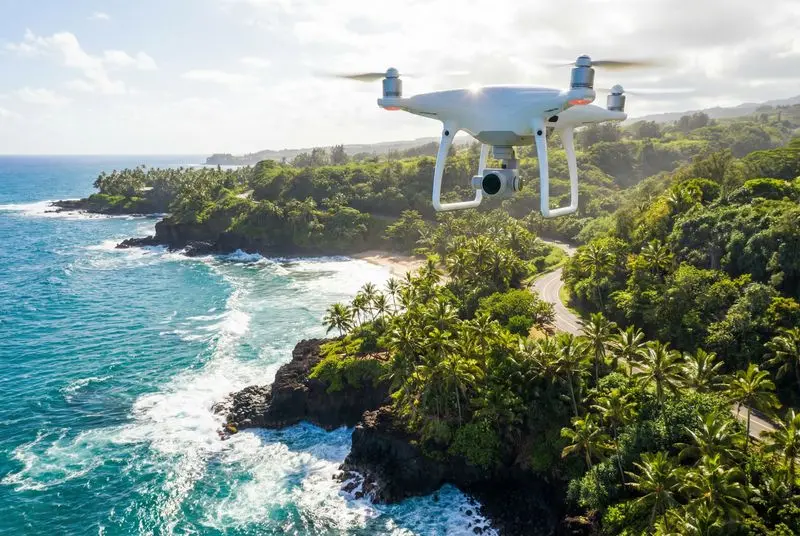
Flying a drone in Hawaii offers the chance to capture some of the most impressive scenery on the planet, from volcanic coastlines to lush rainforests. However, Hawaii has a complex web of regulations that every drone pilot must navigate.This guide provides an overview of the federal, state, and local rules you need to know for 2026, ensuring you can keep your focus on the notable views while staying fully compliant.We will also identify sensitive areas where flying is restricted, outline the penalties for violations, and provide a checklist of tips to help you prepare for every flight. Our goal is to equip you with the knowledge to operate your drone with confidence and respect for Hawaii’s laws and natural beauty.
Federal Drone Laws That Apply in Hawaii
Before we explore Hawaii’s state-specific rules, it’s important to understand that all drone pilots must adhere to the regulations set forth by the Federal Aviation Administration (FAA). These rules provide the foundation for safe drone operation across the entire United States.
For commercial drone pilots operating in Hawaii, this means holding a valid Remote Pilot Certificate, which is obtained by passing the FAA’s Part 107 Aeronautical Knowledge Test. Part 107 regulations govern all flights conducted for business purposes, including real estate photography, cinematic productions, and agricultural surveying.
Recreational pilots, who fly purely for personal enjoyment, are required to take The Recreational UAS Safety Test (TRUST). This free online test covers basic safety guidelines and aeronautical knowledge. After passing, pilots receive a certificate that they must be able to provide if asked by law enforcement.
Here are the key federal regulations that apply to all drone operations in Hawaii:
- Registration: Drones weighing more than 0.55 pounds (250 grams) must be registered with the FAA. You can register your drone through the official FAA DroneZone website.
- Remote ID: As of September 16, 2023, all registered drones are required to broadcast Remote ID information. This acts as a digital license plate, allowing authorities to identify the drone and its operator. The only exception is for drones flown exclusively within an FAA-Recognized Identification Area (FRIA).
- Maximum Altitude: Drones must be flown at or below 400 feet above ground level (AGL) in uncontrolled (Class G) airspace.
- Visual Line of Sight (VLOS): The drone must remain within the pilot’s visual line of sight at all times. The use of a visual observer can supplement this, but the pilot must still be able to see the drone with their own eyes.
- Airspace Authorization: Flying in controlled airspace (Class B, C, D, and E) is strictly prohibited without prior authorization. Pilots can obtain this authorization through the Low Altitude Authorization and Notification Capability (LAANC) system, often accessible via third-party apps, or directly through the FAA DroneZone.
- Respect for Other Aircraft: Drone pilots must always yield the right of way to manned aircraft, such as airplanes and helicopters.
To help plan safe flights, the FAA provides the B4UFLY mobile app, which offers interactive maps and real-time information on airspace restrictions and advisories.
Hawaii-Specific Drone Laws
While the FAA governs the skies, the state of Hawaii has enacted its own laws to manage drone operations, primarily focusing on land use and privacy. Unlike some states, Hawaii does not have a single, comprehensive drone statute. Instead, the rules are found across various state agency regulations and the penal code. You should be aware of these state-level laws before you fly.
Here are the key state-specific drone regulations in Hawaii:
-
State Parks: The Department of Land and Natural Resources (DLNR) explicitly prohibits the use, launching, or landing of drones or any other type of aircraft within Hawaii’s State Parks. This rule is outlined in the Hawaii Administrative Rules Title 13, Subtitle 5, Chapter 146-35. This is a critical regulation to be aware of, as many of Hawaii’s most scenic spots are located within state park boundaries.
-
Harbors: The Department of Transportation (HDOT) Harbors Division has regulations concerning drone use over state harbors. For example, Oahu Harbor Master Notice NO. HMN-O-04-24 restricts drone operations over Oahu’s commercial harbors, requiring permits for any commercial use and prohibiting multiple UAS operations. It is advisable to check with the specific harbor master for any port you plan to fly near.
-
University of Hawaii Property: The use of unmanned aerial vehicles (drones) is prohibited on all University of Hawaii-managed lands without prior authorization. This is specified in Hawaii Administrative Rules § 20-26-29.
-
Misuse of Uncrewed Aircraft: Hawaii law includes offenses for the misuse of drones. Hawaii Revised Statutes § 711-1125 outlines offenses such as taking off or landing in violation of FAA special security instructions or operating a drone in a way that is dangerous to persons or property. Recent legislation, such as SB282, has sought to strengthen these laws, particularly concerning the use of drones over critical infrastructure and for voyeurism.
-
Privacy: While Hawaii does not have a specific drone privacy law, general privacy laws apply. As discussed in a recent KHON2 news report, drone footage can be used in court, but its admissibility depends on whether it was captured lawfully. Flying over private property and recording individuals without their consent could lead to civil or criminal liability under existing privacy and trespass laws.
Local and City Regulations
Beyond state-level rules, drone pilots in Hawaii must also be aware of regulations at the county and city level. While Hawaii does not have a large number of specific municipal drone ordinances, it is common for counties to regulate drone use in local parks and on other county-owned property. For example, many county parks may have signs prohibiting drone flights. It is always a best practice to check for posted signage and to consult the local county’s parks and recreation department for specific rules before flying.
One of the reasons for the limited number of local drone laws is that Hawaii has a legal framework that can be interpreted as giving the state primary authority over aviation matters. However, this has not stopped counties from enacting rules related to land use, privacy, and public nuisance that may affect drone operations. Therefore, pilots should always assume that local rules may be in effect and should do their due diligence to check before every flight.
Where You Can and Can’t Fly in Hawaii
Knowing where you can and cannot fly is one of the most important aspects of being a responsible drone pilot in Hawaii. The state’s unique geography and large number of protected areas mean that many of the most scenic spots are off-limits to drones.
Here is a breakdown of key areas with restrictions:
- National Parks: All National Parks in the United States, including Hawaii’s Haleakalā National Park and Hawaii Volcanoes National Park, have a strict ban on the use of drones. This is a nationwide policy set by the National Park Service (NPS) to protect wildlife and preserve the natural experience for visitors.
- State Parks: As mentioned earlier, the launching, landing, and operation of drones are prohibited in all of Hawaii’s State Parks.
- Airports and Controlled Airspace: As per FAA regulations, you cannot fly in controlled airspace around airports without LAANC authorization. Given the number of airports and military bases in Hawaii, much of the airspace, particularly on Oahu, is controlled. Always check your B4UFLY app before flying.
- Military Installations: Hawaii is home to numerous military bases. Flying over these installations is strictly prohibited and can result in serious penalties.
- Stadiums and Sporting Events: The FAA implements Temporary Flight Restrictions (TFRs) over stadiums during major sporting events. It is illegal to fly a drone within a TFR.
- Wilderness Areas: Flying drones in designated wilderness areas is generally not allowed to protect wildlife and the natural environment.
While there are many restrictions, there are still places to fly. Uncontrolled (Class G) airspace that is not part of a park or other restricted area is generally open to drone flight. Some popular flying locations may be found along coastlines outside of park boundaries, but it is crucial to check local rules and be mindful of private property.
Penalties and Enforcement
Violating federal, state, or local drone laws in Hawaii can result in significant penalties. Both the FAA and state law enforcement have the authority to enforce these regulations.
- Federal Penalties: The FAA can impose substantial fines for violations of its regulations. As of 2026, these fines can range from $1,771 for minor infractions to as much as $36,770 per violation for more serious offenses. Criminal penalties, including imprisonment, are also possible for operations that endanger manned aircraft.
- State Penalties: Under Hawaii law, the misuse of an uncrewed aircraft is a criminal offense. Depending on the severity of the violation, it can be charged as a misdemeanor or even a felony, particularly if it involves privacy violations, interfering with emergency responders, or endangering public safety. Penalties can include fines and jail time.
ignorance of the law is not a defense. Drone pilots are expected to know and follow all applicable regulations.
Tips for Staying Compliant
Staying compliant with drone laws in Hawaii is straightforward if you are diligent and prepared. Here is a checklist of tips to follow for every flight:
- Check the B4UFLY App: Before every flight, consult the FAA’s B4UFLY app to check for airspace restrictions and advisories at your planned location.
- Register Your Drone: If your drone weighs more than 0.55 lbs, ensure it is registered with the FAA and the registration number is clearly marked on the exterior of the drone.
- Get Certified: If you are flying for recreational purposes, you must have your TRUST certificate with you. For commercial flights, you must have your Part 107 Remote Pilot Certificate.
- Respect Privacy: Do not fly over private property or record people without their permission. This is not only a matter of courtesy but also a way to avoid potential legal trouble.
- Check Local Ordinances: Always check for local county or city rules, especially regarding parks and public spaces.
- Keep Your Drone in Sight: Maintain a visual line of sight with your drone at all times.
- Be Aware of Your Surroundings: Pay attention to other aircraft, people, and potential hazards in your flight area.
Helpful Resources
- FAA DroneZone: The official website for registering your drone and accessing other FAA services.
- B4UFLY App: The FAA’s mobile app for checking airspace restrictions.
- Hawaii Department of Land and Natural Resources (DLNR) State Parks: Information on state park rules and locations.
- Hawaii State Legislature: The official website for looking up Hawaii’s statutes and administrative rules.
- Drone Launch Academy Part 107 Course: A comprehensive prep course for the Part 107 exam.