Understanding the anatomy of a drone is one of the fastest ways to become a better, safer, and more confident drone pilot. Whether you’re flying for fun, studying for your Part 107 exam, or building toward a professional drone career, knowing what’s inside your aircraft matters.
At Drone Launch Academy, we teach thousands of pilots every year that mastering flight doesn’t start in the air—it starts with understanding how your drone works on the ground. This guide breaks down drone anatomy, explaining what each part does, how the pieces work together, and why this knowledge is critical for training, maintenance, and real-world flying.
By the end, you’ll clearly understand the components of a drone, how they interact, and how this knowledge supports everything from safe flight to advanced applications like inspections, mapping, and thermal imaging.
Key Takeaways
- Drone parts include both physical parts and drone electronic components that work together to control stability, movement, and performance.
- Knowing the components of a drone—from motors and ESCs to sensors and the flight controller—is essential for professional flying and certification exams.
- Advanced skills like inspections and thermal drone training rely heavily on understanding how drone hardware and sensors interact.
- Drone Launch Academy combines technical knowledge, real-world experience, and structured drone pilot training courses to help pilots turn skills into careers.
What Drone Anatomy Really Means for Pilots

When people talk about drone parts, they’re referring to the physical and electronic systems that allow a drone to fly, stabilize itself, and perform tasks like photography, inspections, or mapping.
The anatomy of a drone includes both drone hardware components (like motors and propellers) and drone electronic components (like the flight controller and sensors). Together, these systems create a flying robot that can hold position, avoid obstacles, and respond instantly to pilot commands.
If you’re serious about becoming a drone pilot, this knowledge helps you:
- Fly more precisely
- Troubleshoot problems faster
- Protect your equipment
- Pass certification exams more easily
- Transition into professional flying roles
Understanding basic drone components is also critical when upgrading drones or choosing the right aircraft for specialized work.
Anatomy of a Drone: Core Drone Components Explained

Here are the core drone components:
Frame (Chassis)
The frame is the drone’s skeleton. It holds all other drone components in place and is usually made of carbon fiber, plastic, or aluminum. Strong but lightweight frames improve flight efficiency and durability, especially in professional environments.
Motors and Propellers
Motors and propellers create lift and thrust. Most quadcopters use four motors—two spinning clockwise and two counterclockwise—to balance rotational forces. Brushless motors are standard because they’re efficient and reliable.
These are some of the most important basic drone components because any imbalance directly affects stability and safety.
Battery
Most drones use intelligent LiPo batteries that monitor temperature, charge cycles, and power output. Battery quality directly affects flight time, safety, and performance.
Understanding battery behavior is a big focus because poor battery management causes many real-world flight incidents.
Electronic Speed Controllers (ESCs)
ESCs control how much power each motor receives. Every motor has its own ESC, allowing the drone to make tiny adjustments that keep it stable in windy conditions or during fast maneuvers.
ESCs are critical drone components and often the first thing to inspect when a motor isn’t behaving correctly.
Flight Controller
The flight controller is the drone’s brain. It processes data from sensors, GPS, and the remote controller, then tells the motors what to do. This is what allows modern drones to hover in place, fly smoothly, and respond instantly to commands.
Sensors (GPS, IMU, Altimeter, Obstacle Sensors)
Sensors provide real-time environmental awareness:
- GPS handles positioning and navigation
- IMU tracks movement and orientation
- Altimeters measure height
- Obstacle sensors help prevent collisions
Professional drones rely heavily on these sensor components for precision work like inspections, mapping, and autonomous flight. These systems form the technical foundation taught in programs like Drone Mapping and Modeling Fundamentals, where pilots learn how to turn sensor data into accurate deliverables.
Receiver and Antennas
The receiver takes signals from the remote controller and sends them to the flight controller. Antennas support strong communication links, ensuring reliable control and live video transmission.
These drone hardware components are critical for long-range and commercial operations.
Camera System
Drone cameras capture light through a lens and convert it into digital images or video. Sensor size, resolution, and lens quality all affect output. Not all drones carry cameras, but for commercial pilots, imaging systems are essential drone components.
This system is essential for professional applications like inspections, surveying, and mapping—especially for pilots learning what drone mapping is and how aerial data is collected accurately.
Gimbal
A gimbal stabilizes the camera across three axes. When the drone moves, the gimbal counters that motion in real time, producing smooth, professional footage.
This combination is foundational for mapping and inspections where image accuracy is critical.
Thermal Sensors
In specialized drones, thermal cameras detect heat differences instead of visible light. These systems are used in inspections, agriculture, search and rescue, and public safety.
How Drone Components Work Together in Real Flight
Here’s what happens during a simple maneuver:
- The pilot moves a joystick
- The transmitter sends a signal
- The receiver passes it to the flight controller
- The flight controller processes sensor data
- ESCs adjust motor speed
- The drone moves smoothly and stays balanced
This coordination between components of a drone is what separates modern UAVs from early, unstable models. Understanding this flow is key to becoming a professional pilot.
Why Drone Anatomy Matters
Pilots who understand their aircraft often perform better on the FAA Part 107 test and make better decisions in the air.
Knowing drone components helps with:
- Emergency handling
- Equipment selection
- Maintenance planning
- Skill specialization
- Career growth
Whether you’re enrolling in your first drone pilot training course or expanding into inspections, understanding the anatomy of a drone gives you a serious advantage.
Check out our Part 107 test prep course if you’re in the process of taking the FAA drone pilot exam.
Become a Drone Pilot Today with Drone Launch Academy
Understanding the different parts of a drone is just the beginning. Knowing how to use that knowledge in real-world flying and paid jobs is what truly sets pilots apart.
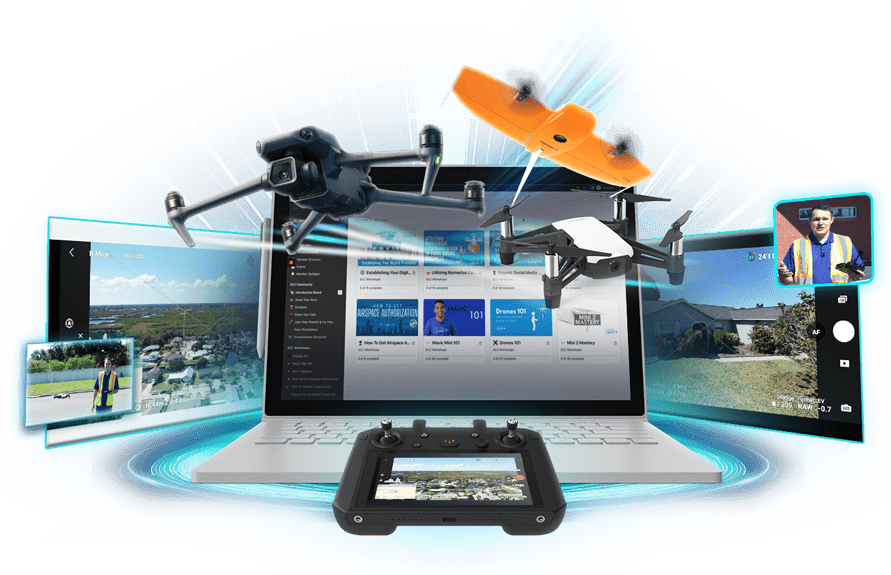
Drone Launch Academy offers structured, step-by-step training designed to take you from beginner to confident professional. Our programs don’t just teach you how to fly—we teach you how drones work, why they behave the way they do, and how to apply that understanding in real scenarios.
What Drone Launch Academy Offers
- Beginner Flight Training: Learn the fundamentals of flying while building a strong foundation around basic drone components and safe operation.
- FAA Part 107 Test Prep: Our proven Part 107 training prepares you to pass the exam with confidence by connecting regulations, airspace knowledge, and drone systems in a way that actually makes sense.
- Industry Skill Training: We offer an advanced drone mapping course covering inspections, mapping, photography, and thermal drone training, helping pilots move into high-demand niches.
- Business & Career Training: From pricing jobs to finding clients, our business-focused courses help pilots understand real-world expectations, timelines, and drone pilot training cost considerations.
- Drone Launch Connect Community: Get feedback, ask questions, and learn from other pilots who are actively flying and building drone careers.
Every course at Drone Launch Academy is built by industry professionals who use drones in the field—not just in theory. That means you learn practical skills, real workflows, and how drone hardware affects performance on actual jobs.
Ready to turn drone interest into drone skills?
Whether you are just getting started or looking to specialize, Drone Launch Academy has a course for your next step. Explore the full DLA course library or start with the beginner-friendly Drones 101 course.
Download the Drone Business Launch Checklist
Before you spend more money on gear, map out the business basics: certification, niche, services, pricing, insurance, deliverables, outreach, and follow-up. This checklist helps you turn a drone idea into a focused business plan.
Need your Part 107 before you start earning with your drone?
If you plan to fly drones for paid work or in support of a business, your next step is earning your FAA Part 107 Remote Pilot Certificate. Drone Launch Academy’s FAA Part 107 Exam Prep Course is built to help you pass the exam on your first try with structured lessons, practice questions, and lifetime access.
Understanding the components of a drone is the first step toward becoming a more capable and confident pilot. Once you know how the hardware works, you can make better decisions about maintenance, upgrades, flight planning, and troubleshooting. If you are ready to take the next step, explore Drone Launch Academy’s course library or start with Drones 101.