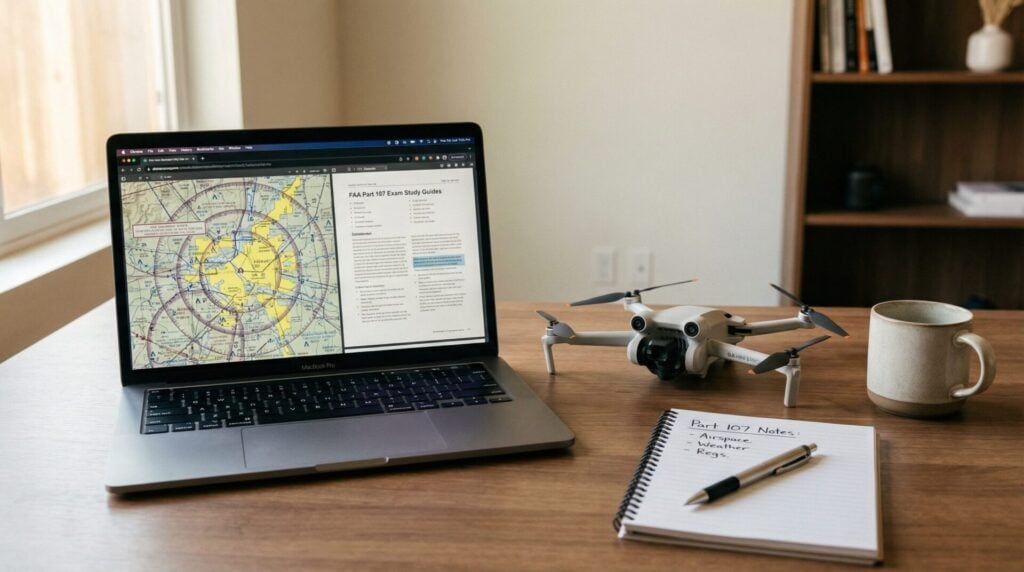
Part 107 study guide materials with drone and laptop on desk

Last Updated: April 14, 2026

The FAA Part 107 exam tests your knowledge of airspace, regulations, weather, and drone operations. Most people pass with 10 to 20 hours of focused study using the right resources. Earning your Remote Pilot Certificate is the essential gateway to commercial drone work, allowing you to fly legally for profit in the United States. Over 300,000 remote pilot certificates have been issued, and the industry continues to grow rapidly. At Drone Launch Academy, David Young and the team have helped thousands of students pass the Part 107 exam on their first attempt. This comprehensive guide, updated for 2026 with the latest FAA guidelines, will show you exactly what to study, how to prepare, and what to expect on test day.

Key Takeaways

  • The Part 107 exam consists of 60 multiple-choice questions, and you need a score of 70 percent (42 correct answers) to pass.
  • Most test-takers require between 10 and 20 hours of study time, typically spread over one to four weeks.
  • Focus your study efforts heavily on airspace classification and sectional charts, as these make up the largest and most challenging portion of the exam.
  • While free resources like the official FAA study guide PDF exist, structured courses significantly improve pass rates and reduce study time.
  • Once earned, your Remote Pilot Certificate remains valid for 24 months before recurrent testing is required.

What Is the FAA Part 107 Exam?

The Part 107 exam is a knowledge test required by the FAA for anyone who wants to fly drones commercially in the United States. Officially called the “Unmanned Aircraft General – Small” test, it covers regulations, airspace, weather, operations, and safety.

If you plan to make money with your drone—whether through real estate photography, mapping, inspections, or filmmaking—you must pass this exam. The certificate separates professional remote pilots from recreational hobbyists, who operate under different, less stringent rules. The regulations have evolved since their introduction, but the core focus remains on integrating drones safely into the national airspace system. David Young at Drone Launch Academy has been teaching Part 107 preparation since the rule was first introduced, helping students navigate the complexities of FAA terminology and procedures.

What Topics Are on the Part 107 Test?

The exam covers five core areas: regulations, airspace, weather, operations, and loading/performance. Each category carries a specific weight, meaning some topics will appear much more frequently than others. Understanding this breakdown is crucial for prioritizing your study time effectively.

Part 107 exam topic breakdown infographic showing percentage weights
Part 107 exam topics weighted by their percentage of the test.
Topic Area Percentage of Exam Approx. Questions Difficulty Level
Drone Operations & Performance 35-45% 21-29 Moderate
Regulations & Operating Rules 15-25% 9-16 Moderate
Airspace Classification & Requirements 15-25% 9-16 Hard
Weather & METAR Reports 10-15% 6-10 Hard
Airport Operations & Radio Communication 5-10% 3-6 Easy-Moderate

The operations section makes up the bulk of the test, covering topics like pre-flight inspections, crew resource management, and emergency procedures. However, the airspace and weather sections often prove the most difficult for beginners. Questions requiring you to read aviation sectional charts or decode METAR weather reports frequently catch unprepared students off guard, as these skills require learning an entirely new visual language.

How Long Does It Take to Study for Part 107?

Most people need 10 to 20 hours of study time to comfortably pass the Part 107 exam. If you study one to two hours per day, you should plan on one to three weeks of preparation before your test date. People with prior aviation backgrounds can often prepare in under a week, while complete beginners might need the full three weeks.

Several factors affect your required study time, including your familiarity with aviation concepts and your preferred learning style. We recommend choosing a study schedule that fits your life. A seven-day intensive plan works well if you can dedicate three hours daily, while a 30-day relaxed schedule is better if you only have 30 minutes a day. In our experience at Drone Launch Academy, students who follow a structured study plan and take consistent practice exams pass at rates well above 95 percent.

What Are the Best Part 107 Study Resources?

The best study resources combine the official FAA study guide with a structured video course and practice exams. Free options certainly work, but paid courses offer higher pass rates, save significant time, and provide expert explanations for complex topics.

Resource Type Cost Best For
FAA Remote Pilot Study Guide Official PDF guide Free Comprehensive reference material
Drone Launch Academy Part 107 Course Video course + practice tests Paid Structured learning, highest pass rates
Quizlet Flashcards Digital flashcards Free Memorizing definitions and acronyms
YouTube Tutorials Video explanations Free Visual learners needing help with specific topics
King Schools Practice Tests Practice exams Free/Paid Assessing test readiness before exam day
Airman Knowledge Testing Supplement Official testing figures Free Practicing with the exact charts used on the exam

Structured courses outperform self-study because they organize the material logically and highlight exactly what the FAA tests. The Drone Launch Academy course, for example, features detailed video modules, comprehensive study guides, and a pass guarantee that removes the financial risk of failing.

How to Create a Part 107 Study Plan

Start your preparation with regulations and airspace, as these are the heaviest and most complex topics. Then move on to weather and operations, saving full practice exams for the final two to three days before your test.

A solid week-by-week study plan begins by reading the official materials or watching course modules to build foundational knowledge. During the second week, focus intensely on learning to read sectional charts and weather reports. By the third week, you should be taking practice quizzes on individual topics to identify weak areas. Your daily study sessions should be focused and free of distractions. To improve retention, try teaching the concepts you’ve learned to someone else, or use flashcards to drill difficult acronyms and regulations.

What Are the Hardest Part 107 Topics?

Student studying aviation sectional chart for Part 107 exam preparation
Learning to read sectional charts is one of the most challenging—and most important—parts of Part 107 preparation.

Sectional chart interpretation, METAR/TAF weather reports, and airspace classification consistently trip up the most test-takers. These three areas deserve extra study time, as they require you to analyze visual data rather than simply recalling facts.

Sectional charts are dense maps filled with numbers, colors, and symbols indicating different types of airspace, elevations, and hazards. You must learn to identify Class B, C, D, E, and G airspace boundaries and their respective altitude limits. METAR reports are equally challenging; they look like strings of random letters and numbers but actually contain critical weather data. You must learn to decode these strings to determine visibility, cloud cover, and wind conditions. David Young’s top tip for students is to spend at least 40 percent of your study time on sectional charts alone, as they are the number one reason people fail the exam.

How to Register and Schedule Your Part 107 Exam

Confident drone pilot arriving at testing center for Part 107 exam
Arriving prepared at the testing center makes all the difference on exam day.

Register for an FAA Tracking Number (FTN) through the IACRA website, then schedule your exam at a PSI testing center. The test costs $175 and takes about two hours to complete.

The registration process requires creating an account on the Integrated Airman Certification and Rating Application (IACRA) system to receive your FTN. Once you have this number, you can create an account on the PSI website to find a local testing center and book your exam slot. On test day, you must bring a valid, unexpired government-issued photo ID that includes your signature and physical address. Expect a quiet, monitored testing environment where you will be provided with a physical copy of the Airman Knowledge Testing Supplement to reference during the exam.

Is the Part 107 Exam Difficult?

The Part 107 exam isn’t difficult if you prepare properly. The national pass rate hovers around 80 to 90 percent, and students who use structured study courses pass at even higher rates.

Common reasons people fail include underestimating the difficulty of sectional charts, relying solely on outdated free practice tests, or rushing through the exam without carefully reading the questions. The FAA is known for writing tricky questions that test your reading comprehension as much as your aviation knowledge. You can avoid these mistakes by taking multiple full-length practice exams and consistently scoring above 85 percent before scheduling your real test. If you do not pass, you must wait 14 days before you are allowed to retake the exam, and you will have to pay the $175 testing fee again.

What Happens After You Pass Part 107?

After passing, you will receive a temporary certificate within days and your permanent Remote Pilot Certificate within six to eight weeks. You will need to complete recurrent training every 24 months to maintain your commercial flying privileges.

Once you pass the exam at the PSI center, your results will be transmitted to the FAA. You must then log back into IACRA to link your test results and complete the final application for your certificate. The FAA will conduct a background check, and once cleared, you can print a temporary certificate. Your permanent, plastic Remote Pilot Certificate will arrive in the mail later. With your license in hand, you can begin legally charging for your drone services. Consider exploring specialized training, such as the advanced courses offered by Drone Launch Academy, to build your skills in mapping, roof inspections, or real estate photography. You might also want to learn about drone pilot jobs and how to make money with a drone now that you’re certified.

Frequently Asked Questions About the Part 107 Study Guide

How many questions are on the Part 107 test?

The Part 107 exam consists of 60 multiple-choice questions. Each question has three possible answer choices (A, B, or C). For more details, see our complete guide on how many questions are on the Part 107 test.

What score do you need to pass Part 107?

You must score at least 70 percent to pass the exam, which means you need to answer a minimum of 42 out of 60 questions correctly.

Can you use a calculator on the Part 107 exam?

Yes, you are allowed to use a basic, non-programmable calculator during the exam. However, most testing centers will provide one for you, or you can use the calculator built into the testing software.

How much does the Part 107 test cost?

The exam fee is $175, payable directly to the PSI testing center when you schedule your appointment. For a full breakdown of all costs involved, check out our article on drone pilot training cost.

Do you need flight experience to take Part 107?

No, the Part 107 exam is entirely a written knowledge test. There is no practical flight proficiency requirement to earn your Remote Pilot Certificate.

How often do you need to renew your Part 107?

Your certificate never officially expires, but you must complete a free online recurrent training course every 24 months to maintain your commercial flying privileges.

What happens if you fail the Part 107 exam?

If you fail, you must wait 14 calendar days before you can retake the exam. You will also have to pay the $175 testing fee again for the retake.

Is Part 107 changing in 2026?

While the core regulations remain stable, the FAA periodically updates the exam to reflect new technologies and operational waivers. Always ensure your study materials are current for the year you plan to test.

TL;DR

The Part 107 exam is a 60-question multiple-choice test covering regulations, airspace, weather, and operations. You need a 70 percent to pass. Most people prepare in 10 to 20 hours using the FAA study guide and a structured course. Focus extra time on sectional charts and METAR reports, as they are the hardest sections. Register through IACRA, schedule at a PSI center for $175, and you will have your Remote Pilot Certificate within weeks.

Article By:

Drone Launch Academy has helped over 40,000 drone pilots learn how to fly drones, pass the Part 107 Exam, and learn the skills they need to start making money with drones.

Share this post