
Drone Laws in California
Your complete 2026 guide to flying drones legally in California.
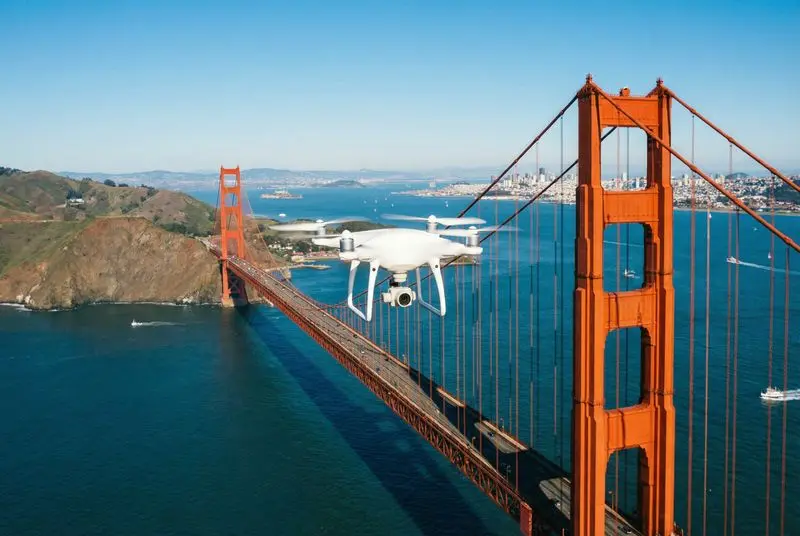
California, with its coastlines, major cities, and varied terrain, is a popular location for drone pilots. From capturing cinematic shots of the Golden Gate Bridge to surveying agricultural fields in the Central Valley, there are many opportunities for drone pilots. However, California also has a complex and evolving set of regulations that both recreational and commercial drone operators must navigate. Understanding these rules is needed to fly legally and safely.
Federal Drone Laws That Apply in California
All drone operations in California are subject to federal regulations established by the Federal Aviation Administration (FAA). These rules provide a baseline for safe and responsible drone use across the United States. Both commercial and recreational pilots must be familiar with these requirements.
For Recreational Flyers
If you are flying your drone purely for fun and personal enjoyment, you must follow the FAA’s guidelines for recreational flyers. A key requirement is to take The Recreational UAS Safety Test (TRUST), a free online test that provides education on safety and regulatory requirements. You must be able to provide proof of passing this test if asked by law enforcement. Additionally, if your drone weighs more than 0.55 pounds (250 grams), it must be registered with the FAA through the DroneZone website.
Key federal rules for recreational pilots include:
- Fly at or below 400 feet in uncontrolled (Class G) airspace.
- Keep your drone within your visual line of sight or that of a visual observer who is co-located with you.
- Obtain authorization before flying in controlled airspace (Class B, C, D, and E) through LAANC or DroneZone.
- Never interfere with manned aircraft, and always give way.
- Do not operate your drone in a dangerous or reckless manner.
For Commercial Pilots
Anyone operating a drone for business or commercial purposes must fly under the FAA’s Small UAS Rule (Part 107). This requires the remote pilot in command to hold a Remote Pilot Certificate, which is obtained by passing the FAA’s Aeronautical Knowledge Test. Part 107 sets a framework for commercial operations, covering everything from operating limitations to airspace restrictions.
Key federal rules for commercial pilots include:
- Drone must weigh less than 55 pounds, including payload.
- Maintain visual line of sight of the drone at all times.
- Operations are limited to daylight hours or civil twilight with appropriate anti-collision lighting.
- Maximum groundspeed of 100 mph (87 knots).
- Maximum altitude of 400 feet above ground level (AGL) or, if flying over a structure, 400 feet above the structure’s uppermost limit.
- No operations from a moving vehicle unless in a sparsely populated area.
Remote ID Requirement
As of September 16, 2023, most drones required to be registered must broadcast Remote ID information. This rule, often called a “digital license plate” for drones, enhances safety and security by allowing the FAA, law enforcement, and other federal agencies to identify drones in flight. Ensure your drone is compliant with this regulation before flying.
For the most current and detailed information, always consult the official FAA website and use tools like the B4UFLY app to check airspace restrictions before every flight.
California-Specific Drone Laws
Beyond the federal rules, California has enacted several of its own laws that directly impact drone operations. These laws often focus on issues of privacy, public safety, and environmental protection. All pilots need to be aware of these state-level statutes.
Interference with Emergency Personnel (AB 1680 & SB 807)
California has taken a strong stance against the interference of drones with emergency response efforts, largely prompted by incidents where drones hindered aerial firefighting operations.
- Assembly Bill 1680 (2016) makes it a misdemeanor for a drone to interfere with the efforts of firefighters or other emergency responders during an emergency.
- Senate Bill 807 (2016) provides civil immunity to any emergency responder who damages a drone that was interfering with their ability to provide emergency services. if your drone gets in the way of a firefighting helicopter, and the fire department has to take it down, you have no legal recourse.
Privacy and Voyeurism (AB 856)
Privacy is a significant concern in California, and drone laws reflect this. Assembly Bill 856 (2015) amended the state’s civil code to specifically address the use of drones for invading privacy. This law makes it illegal to fly a drone into the airspace above someone’s private property to capture images or sound recordings of them engaging in a private, personal, or familial activity without their consent. Violations can lead to significant fines, ranging from $5,000 to $50,000.
Wildlife and Environmental Protection
The California Department of Fish and Wildlife (CDFW) has established several regulations to protect wildlife from drone-related disturbances.
- Harassment of Animals (CCR Title 14, Section 251.1): This regulation prohibits the intentional harassment of any bird or mammal, which is defined as an act that disrupts an animal’s normal behavior patterns, such as breeding, feeding, or sheltering.
- Use on CDFW Lands (CCR Title 14, Section 550(aa)): Operating a drone on any land owned or managed by the CDFW is prohibited without a specific Special Use Permit. These permits are typically reserved for research or management activities.
- Hunting (CCR Title 14, Section 251): It is illegal to use a drone to assist in hunting any big game mammal. This includes using a drone to locate animals 48 hours before or after the hunting season.
Drones Over State Parks and Highways
- State Parks (CCR Title 14, Section 4351): While drones are generally allowed in many state parks, they are explicitly prohibited in designated State Park wilderness areas, cultural preserves, and nature preserves. Individual park districts may also impose their own restrictions, so You should check with the specific park you plan to visit.
- State Highway System: Flying a drone over any part of the California State Highway System (SHS), which includes highways, interstates, rest areas, and vista points, is prohibited without an encroachment permit from Caltrans.
Local and City Regulations
Many cities and counties in California have established their own ordinances regarding drone use, often restricting flights in parks, near public buildings, and during large events. The state does not have a preemption law, meaning local governments are free to create their own drone rules. This patchwork of regulations requires pilots to be extra diligent in checking local laws before flying. Below are some examples of local ordinances across the state.
| Jurisdiction | Ordinance / Regulation | Key Provisions |
|---|---|---|
| Los Angeles County | Municipal Code 17.12.420 | Prohibits the operation of drones within Los Angeles County parks. |
| Sacramento County | County Code 9.36.068 | Prohibits drones in county parks except in areas specifically designated for that purpose. |
| San Francisco | Park Code Sec. 3.09 | Prohibits the use of model aircraft, including drones, in all city parks without permission from the Recreation and Park Department. |
| City of San Diego | Municipal Code 63.44 (B) | Prohibits the operation of any “contrivance for flying” in Balboa Park and Mission Bay Park. |
| City of Malibu | Filming Permit | Requires a filming permit for any commercial drone operations. Much of Malibu’s airspace is also under National Park jurisdiction, which is a no-fly zone. |
| City of Hermosa Beach | Ordinance 16-1363 | Requires a city-issued permit to operate a drone and prohibits flying less than 350 feet above any public school. |
| Orange County | OC Parks Rules | Prohibits the operation of drones in most Orange County parks and wilderness areas. |
Note: This is not an exhaustive list. Many other municipalities, such as Yorba Linda, Calabasas, and La Mesa, have their own specific drone ordinances. Always check the municipal code for the specific city or county where you intend to fly. A good practice is to search for “[City Name] municipal code drone” before any flight.
Where You Can and Can’t Fly in California
Navigating the skies of California requires an awareness of the many places where drone flights are restricted or prohibited entirely. Beyond the general airspace classifications, several specific types of locations have their own rules.
National Parks
Flying a drone in any of the nine National Parks located in California is strictly prohibited. The National Park Service (NPS) issued a nationwide ban on the launching, landing, or operating of unmanned aircraft on all lands and waters administered by the NPS. This includes iconic parks like Yosemite, Joshua Tree, and Redwood National Park. This ban is in place to protect wildlife, preserve the natural soundscape, and ensure the safety and enjoyment of park visitors.
State Parks
As mentioned earlier, California State Parks have a nuanced approach. While not a blanket ban, drones are prohibited in certain protected areas within the park system, including wilderness areas, nature preserves, and cultural preserves (CCR Title 14, Section 4351). Furthermore, individual park districts have the authority to issue their own closures or restrictions. For example, the Orange Coast District, which includes popular beaches like Huntington and Bolsa Chica, has a complete ban on UAS operations. Always check the specific regulations for the state park you wish to visit.
Other Restricted Areas
- Airports: You must have authorization to fly in the controlled airspace surrounding airports. The B4UFLY app is the best tool to visualize these areas.
- Military Installations: Flying over military bases is prohibited. These areas are often marked as restricted airspace on FAA charts.
- Stadiums and Sporting Events: The FAA implements Temporary Flight Restrictions (TFRs) over stadiums during major sporting events. It is illegal to fly a drone within a 3-nautical-mile radius of the stadium, from one hour before to one hour after the event.
- Critical Infrastructure: Be mindful of flying over critical infrastructure such as power plants, water treatment facilities, and correctional facilities. While not all have explicit flight restrictions, flying over them could be perceived as a security threat.
- Wilderness Areas: In addition to state-designated wilderness, many federally managed wilderness areas also prohibit motorized equipment, including drones.
Penalties and Enforcement
Violating drone laws in California can result in significant penalties from both federal and state authorities.
- Federal Penalties: The FAA has the authority to issue substantial fines for violations of its regulations. As of 2025, these fines can range from $1,771 to $36,770 per violation for careless or reckless operations. Operating a drone in a way that endangers the national airspace system can also lead to criminal charges.
- State Penalties: Violating state laws, such as interfering with emergency responders or invading privacy, can result in misdemeanor charges, fines, and even jail time. For example, the privacy law (AB 856) carries civil fines of $5,000 to $50,000.
- Local Penalties: Many city and county ordinances classify drone violations as misdemeanors, which can be punishable by fines and other local penalties.
Tips for Staying Compliant
With a complex web of federal, state, and local rules, staying compliant can seem daunting. Here are some practical tips to help you fly safely and legally in California:
- Check B4UFLY Before Every Flight: This is the single most important habit for any drone pilot. The B4UFLY app provides up-to-date airspace information and restrictions.
- Know Your Local Ordinances: Before flying in a new location, do a quick web search for “[City Name] drone laws” or “[County Name] park drone rules.”
- Register and Certify: Ensure your drone is registered with the FAA if it weighs over 250g. Recreational pilots must have their TRUST certificate, and commercial pilots must have their Part 107 license.
- Respect Privacy: Avoid flying over private property without permission, and never use your drone to capture images or recordings where people have a reasonable expectation of privacy.
- Keep Your Distance from Wildlife: Give wildlife a wide berth. If you notice an animal reacting to your drone, back away immediately.
- Stay Out of the Way of Emergencies: If you see emergency vehicles or a fire, do not fly your drone in the area. Interference is illegal and dangerous.
Helpful Resources
- FAA DroneZone: For registering your drone and obtaining airspace authorizations.
- B4UFLY App: The official FAA app for checking airspace.
- California Department of Transportation (Caltrans) Aeronautics: State-level aviation authority.
- California Legislative Information: To look up state statutes and bills.
- Drone Launch Academy Part 107 Course: For those looking to become certified commercial drone pilots.
This guide is for informational purposes only and should not be considered legal advice. Drone laws are subject to change. Always check the latest regulations from the FAA and local authorities before flying.
Internal Links
- Return to the main Drone Laws by State Directory.
- Read about drone laws in neighboring states: Arizona, Nevada, and Oregon.
← Back to Drone Laws by State Directory
Disclaimer: Drone laws are constantly evolving. While we strive to keep this guide updated, you should always verify local ordinances and check the FAA B4UFLY app before flying. This page is for educational purposes and does not constitute legal advice.
Sources: FAA UAS | NCSL State Drone Law Landscape | FAA Remote ID | FAA Part 107