
The FAA Part 107 knowledge test — officially called the FAA Unmanned Aircraft General (UAG) knowledge test — contains 60 scored multiple-choice questions, plus 5 unscored “validation” questions the FAA is testing out, so you’ll see 65 on screen. The time limit is 120 minutes, and you need to answer at least 42 of the 60 scored questions correctly to pass, which works out to a 70% passing score. You can’t tell which 5 questions don’t count, so treat every one like it does.
The test is administered at PSI-approved testing centers nationwide. You’ll sit at a computer in a proctored environment with no open books, no personal notes — just you, the screen, and an FAA-provided chart supplement booklet to reference during the exam.
| Detail | Info |
| Number of Questions | 60 scored + 5 unscored (65 on screen) |
| Time Allowed | 120 minutes (2 hours) |
| FAA Part 107 passing score | 70% (42 out of 60 scored questions) |
| Exam Fee | $175 per attempt, paid to PSI |
| Where to Take It | PSI-approved testing centers |
| Flight hours or flight test | None required |
| Official Exam Name | Unmanned Aircraft General – Small (UAG) |
Want to see what those questions actually feel like? Our Part 107 exam prep course includes five full-length practice tests built like the real exam, and 99.54% of our students pass on their first try. Rather start free? Try our 21 Part 107 practice questions.
That’s the core of it, but knowing how many questions are on the Part 107 test is just the starting point. Understanding what those 60 questions cover, how to prepare, and what happens after you pass is where the real value is.
Key Takeaways
- The Part 107 exam is 60 scored multiple-choice questions (plus 5 unscored ones), administered in 120 minutes at PSI testing centers, with a 70% passing score (42 correct answers) required.
- Five topic areas are tested, and Regulations now carries the most weight (48% since September 29, 2025). Airspace questions are still the ones people miss most, because they require reading sectional charts.
- Chart questions are changing on October 26, 2026. The test can now show current sectional chart images that aren’t in the printed testing supplement, so learn to read charts instead of memorizing figures.
- Most candidates need 15–20 hours of study to pass; those without aviation backgrounds should plan for 25–30 hours, with dedicated time for chart practice.
- Registration requires an FAA Tracking Number (FTN) created through IACRA before you can schedule the exam, so do it first.
- The certificate requires free FAA online recurrent training (ALC-677) every 24 months, completed through the FAA Safety Team website — no in-person PSI exam required.
How Many Questions Are on the Part 107 Test and What Topics Are Covered?
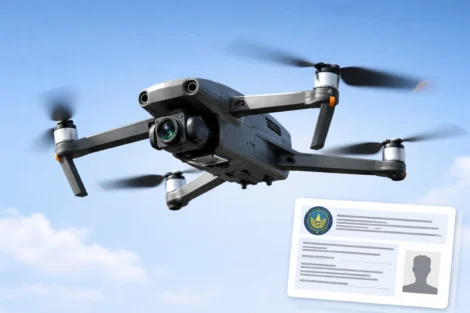
The FAA Part 107 exam covers five knowledge areas from the FAA’s Airman Certification Standards (ACS), but the weighting changed on September 29, 2025. The current breakdown comes from PSI’s UAG Applicant Information Bulletin, and it puts much more weight on regulations than older study guides do. Knowing the weighting helps you study smarter, not harder.
Here’s how the five FAA Part 107 test topics break down:
| Topic Area | Share of Scored Questions | About How Many (of 60) | What to Expect |
| Regulations | 48% | ~29 | FAA rules, waivers, remote pilot responsibilities, certificate requirements |
| Operations | 25% | ~15 | Emergency procedures, crew resource management, radio comms, aeronautical decision-making, airport ops, maintenance |
| Airspace Classification & Operating Requirements | 20% | ~12 | Class B/C/D/E/G airspace, TFRs, NOTAMs, sectional charts |
| Weather | 5% | ~3 | METARs, TAFs, weather charts, wind, visibility, cloud ceilings |
| Loading & Performance | 2% | ~1 | Weight and balance, performance charts, drone limitations |
Percentages from PSI’s UAG Applicant Information Bulletin (effective September 29, 2025). Question counts are our rounded estimates, not official FAA numbers.
Note:
- Regulations is now the biggest category at 48%, nearly half the test.
- Regulation questions tend to be scenario-based, testing what a UAV pilot should do in a given situation rather than requiring rule-number recitation.
- Operations (25%) and Airspace (20%) make up most of the rest. Regulations and airspace together are about two-thirds of the exam.
- Weather (5%) and Loading & Performance (2%) are small slices now, but don’t skip them. Weather questions often involve reading a METAR or spotting hazardous conditions in a forecast, and you’ll need those skills to fly safely anyway.
Airspace Questions: The Most Commonly Missed Category
Airspace classification is where many candidates lose unexpected points. The challenge isn’t that the rules are complex — it’s that applying them requires reading a sectional aeronautical chart, a skill that takes hands-on practice. Questions may ask you to identify airspace class above a specific airport, determine whether authorization is required before flying, or interpret a NOTAM or TFR boundary.
Budget dedicated time for chart practice. Flashcards won’t cut it here.
Heads Up: Chart Questions Change on October 26, 2026
Starting October 26, 2026, the FAA says the Part 107 (UAG) test will include image-based questions using current sectional chart images that aren’t in the printed testing supplement (FAA Airman Testing Community Advisory, August 2026). The supplement book is still handed out for now, and the FAA hasn’t set a date to retire it. The takeaway: don’t memorize specific figures. Learn to actually read a sectional, so any chart on the screen makes sense.
How Hard Is the Part 107 Test, Really?
Honestly? It’s a serious exam — but it’s very passable with the right preparation. Candidates who follow a structured study plan consistently report higher first-attempt success rates. The candidates who struggle are almost always those who underestimated the preparation required.
The Part 107 initial knowledge exam is closed-book and computer-based. No outside materials are permitted beyond the FAA-supplied test supplement. Difficulty concentrates in three areas:
- Reading sectional aeronautical charts — requires visual interpretation, not memorization
- FAA regulation interpretation — scenario-based, testing applied judgment
- Weather decoding — METARs, TAFs, and weather charts require familiarity with aviation-specific formats
The good news: the FAA publishes sample questions and all the source material the test is built from, so steady practice with Part 107-style questions gets you ready for test day, as long as you focus on understanding the answers instead of memorizing them. Candidates who study consistently and take multiple timed practice exams routinely pass on their first attempt.
If the chart and regulation questions are the part that worries you, you’re in good company. That’s exactly what our Part 107 test prep course spends the most time on. Over 30,000 students have used it to get certified, and 99.54% passed on their first try.
Part 107 Exam Cost, Registration, and What to Expect on Test Day
The Part 107 exam costs $175, paid to PSI when you book. Always verify the current amount through PSI’s testing portal when you register. Here’s our full breakdown of the Part 107 exam cost, including what a retake costs.
Here’s the full registration process:
Step 1 — Create your FAA Tracking Number (FTN) via IACRA
Before anything else, you’ll need to get your FTN registered in the FAA’s IACRA system — PSI needs your FTN before you can book the test. Having it set up also means you can submit your certificate application in IACRA as soon as you pass.
Step 2 — Schedule through PSI
Once you have your FTN, use PSI’s testing center portal to find a location and book your exam date. Here’s our step-by-step guide to scheduling the Part 107 exam.
Step 3 — Arrive with a valid government-issued ID
Bring a current government-issued photo ID. No ID, no test.
Step 4 — Take the exam
You’ll work through 65 on-screen questions (60 scored, 5 unscored) with access to the printed FAA Airman Knowledge Test Supplement. Starting October 26, 2026, some chart images will also appear right in the questions. PSI’s testing software has a built-in four-function calculator. A small, basic calculator (add, subtract, multiply, divide only) may be allowed if the proctor clears it, but plan on using the on-screen one. Phones, notes, and your own pens or pencils aren’t allowed in the testing room.
Step 5 — Get your score and apply
Your score report prints immediately after the exam. If you pass, log in to IACRA to submit your remote pilot certificate application. A temporary certificate arrives digitally; the physical card follows by mail within a few weeks.
Getting the FTN step right before anything else is the single most important procedural detail in the entire Part 107 exam process.
How to Study for the Part 107 Test: Building a Winning Prep Plan

Most candidates need 15–20 hours of focused study to pass on their first attempt. Without any aviation background, plan for 25–30 hours. Broken into daily sessions over two to four weeks, that’s very manageable.
For topics like weather and airspace, where judgment matters as much as memorization, expert-led instruction can dramatically shorten your learning curve.
Here’s a four-phase approach that works:
- Benchmark cold: Take a Part 107 practice test before you’ve studied anything (our free 21-question practice test is a good place to start). The goal isn’t to score well — it’s to identify your knowledge gaps so you can prioritize.
- Systematic content review: Work through a structured Part 107 study guide covering each topic area: regulations, airspace, weather, loading and performance, and operations. Don’t skip topics that seem minor.
- Drill practice questions: This is the single most effective preparation technique. Working through lots of Part 107-style questions, and reading why each answer is right or wrong, builds the understanding you need on test day. Don’t just memorize answers: the live questions aren’t published, and starting October 26, 2026, some will use chart images you haven’t seen before.
- Simulate the full exam: At least once before your test, complete a full 60-question practice exam under 120-minute time conditions. This builds pacing confidence and reduces test-day anxiety.
Prefer to have the study plan laid out for you? Our course walks you through every topic with short video lessons, quizzes, and timed practice exams, so all you have to do is show up and study.
Using Practice Exams the Right Way
Don’t just note whether you got a question right or wrong — read the explanation for every incorrect answer and every correct answer you weren’t fully confident about. The FAA rotates question phrasing, so candidates who rely on pattern-matching rather than genuine understanding often get tripped up. The goal is comprehension, not memorization.
Mastering Sectional Charts
Sectional chart reading deserves at least 3–5 dedicated hours separate from your general study time. Work with the chart excerpts in the FAA testing supplement, then practice on current sectional charts too, since starting October 26, 2026, the test can show chart images that aren’t in the supplement. Practice identifying airspace boundaries and get comfortable reading the symbology. The more time you spend with real charts, the more confident you’ll feel when those questions appear on test day.
After You Pass: Recurrency, Renewal, and What Your Certificate Allows
Passing the Part 107 exam earns you a drone remote pilot certificate that opens real professional doors, and understanding what that certificate allows, and what it requires going forward, is just as important as passing the test itself. Here’s what it authorizes:
- Commercial UAS operations with aircraft under 55 lbs
- Flying in Class G airspace without prior authorization
- Flying in controlled airspace (Class B, C, D, and surface-area Class E) with ATC authorization, usually through LAANC or FAA DroneZone
- Operations below 400 ft AGL (with defined exceptions near structures)
- Day, civil twilight, and night operations (at night and during civil twilight, your drone needs anti-collision lighting visible for 3 statute miles)
- Flights within the visual line of sight
What it does not authorize without a specific FAA waiver: Beyond visual line of sight operations, flight over moving vehicles or people without meeting the specific category requirements defined under the FAA’s Operations Over People rule (e.g., drone weight, exposed rotating parts, remote ID compliance), and operations outside standard altitude and airspace limits.
On recurrency: Every 24 calendar months, you must complete the free FAA online recurrent training course (ALC-677), available through the FAA Safety Team website. The course ends with an online multiple-choice knowledge check that you complete in a single session (90-minute limit). No in-person PSI exam or fee is required for recertification. These requirements are distinct from the TRUST (The Recreational UAS Safety Test), which applies to recreational flyers — a separate rule that sometimes creates confusion.
The initial knowledge test is the gateway to a legitimate commercial drone career, and the right preparation makes all the difference.
FAQs
How many questions are on the Part 107 knowledge test?
The Part 107 knowledge test has 60 scored multiple-choice questions, plus 5 unscored validation questions mixed in (65 total on screen). You’ll have 120 minutes to complete the exam at a PSI-approved testing center, and questions are drawn from five topic areas: regulations, airspace, weather, loading and performance, and operations.
What is the passing score for the Part 107 exam?
You need a score of 70% or higher to pass, which means answering at least 42 out of 60 questions correctly. If you score below 70%, you can retake the exam after a 14-day waiting period.
How much does the Part 107 test cost?
The exam currently costs $175, payable when you schedule through PSI. This fee applies to the initial knowledge test. Recurrent training is completed online for free. Always confirm the current fee on PSI’s portal, as pricing can change.
Learn more about drone pilot training costs here.
How long should I study for the Part 107 test?
Most candidates without an aviation background need 25–30 hours; those with some aviation familiarity typically need 15–20 hours. A structured four-phase approach — benchmark test, content review, practice drilling, and timed simulation — is the most reliable path to passing on your first attempt.
Can I retake the Part 107 test if I fail?
Yes. You must wait 14 calendar days before retaking the exam and pay the $175 fee again. There’s no limit on retakes, but use the waiting period productively — review your score report, identify weak areas, and focus your study there before scheduling again.
Do I need flight hours or a flight test to get my Part 107?
No. There’s no minimum flight time and no practical flight test. For your first certificate, the knowledge test is the only exam you need to pass.
Need your Part 107 before you start earning with your drone?
If you plan to fly drones for paid work or in support of a business, your next step is earning your FAA Part 107 Remote Pilot Certificate. Drone Launch Academy’s FAA Part 107 Exam Prep Course is built to help you pass the exam on your first try with structured lessons, practice questions, and lifetime access.
Download the Part 107 Study Checklist
Use this checklist to make sure you know what to study before scheduling your FAA exam. It covers airspace, weather, regulations, loading, operations, and practice-test readiness so you can see what still needs work before test day.
Want to turn drone skills into paying clients?
Getting certified is only the first step. If you want a clear roadmap for pricing, outreach, client acquisition, and building a profitable drone business, Drone to $1K walks you through the business-building process step by step.
The rules, costs, and registration steps can feel complicated at first, but they all point toward the same outcome: becoming a legal, confident commercial drone pilot. Once you understand the basics, your next move is to prepare for the exam with a structured study system. Start with Drone Launch Academy’s FAA Part 107 Exam Prep Course, then use your certificate to pursue the drone work that fits your goals.