Last Updated: June 9, 2026
Agricultural drones are quickly becoming one of the most practical tools in modern farming. They can scout crops, map fields, monitor plant health, spray or spread materials, check livestock, and help farmers make faster decisions without driving heavy equipment into every acre.
For drone pilots, agriculture can also become a serious commercial niche. But it’s not a “buy a drone on Monday, spray crops on Friday” market. The work can involve FAA rules, state applicator requirements, insurance, chemical-handling responsibilities, agronomy knowledge, and equipment that costs far more than a typical camera drone.
At Drone Launch Academy, we’ve helped more than 40,000 pilots learn to fly, pass the Part 107 exam, and build paid drone skills.1 Founder David Young is a pilot, FAA-certified Advanced Ground Instructor, drone enthusiast, CPA, and founder of Drone Launch Academy, which is why we tend to look at agricultural drones from both the aviation and business side.2
Key Takeaways: Agricultural drones are used for scouting, mapping, crop-health analysis, spraying, spreading, seeding, livestock checks, and farm monitoring. In the United States, most paid agricultural drone work starts with Part 107, while spray or dispensing operations may also trigger Part 137 and state applicator rules. Costs vary widely, but a real spray-drone operation includes much more than the aircraft. Beginners should usually start with Part 107, safe flight skills, mapping or scouting fundamentals, and farmer conversations before investing in heavy application equipment.
What Are Agricultural Drones?
Agricultural drones are unmanned aircraft used in farming to collect crop data, inspect land, monitor plant health, apply materials, or support daily farm decisions. They can be small camera drones used for scouting, multispectral drones used for crop-health insights, or larger payload drones designed for spraying and spreading.
Michigan State University describes modern agricultural drones as “flying tractors” because they can perform multiple farm tasks with different hardware attachments, including spraying crops, spreading fertilizer, sowing seeds, monitoring livestock, mapping drainage, and measuring crop health.3 DJI Agriculture’s product ecosystem shows the same split between large Agras application aircraft and tools such as the Mavic 3M for field observation and planning.4
What Are Agricultural Drones Used For?
Agricultural drones are most often used for crop scouting, plant-health imaging, field mapping, spray application, fertilizer or seed spreading, livestock checks, and farm-security monitoring. The best use depends on whether the farm needs better information, faster application, safer access, or a more efficient way to cover difficult ground.
For many operators, visual scouting is the easiest place to start. A drone can identify standing water, crop damage, pest pressure, irrigation problems, or equipment issues without walking the whole field.
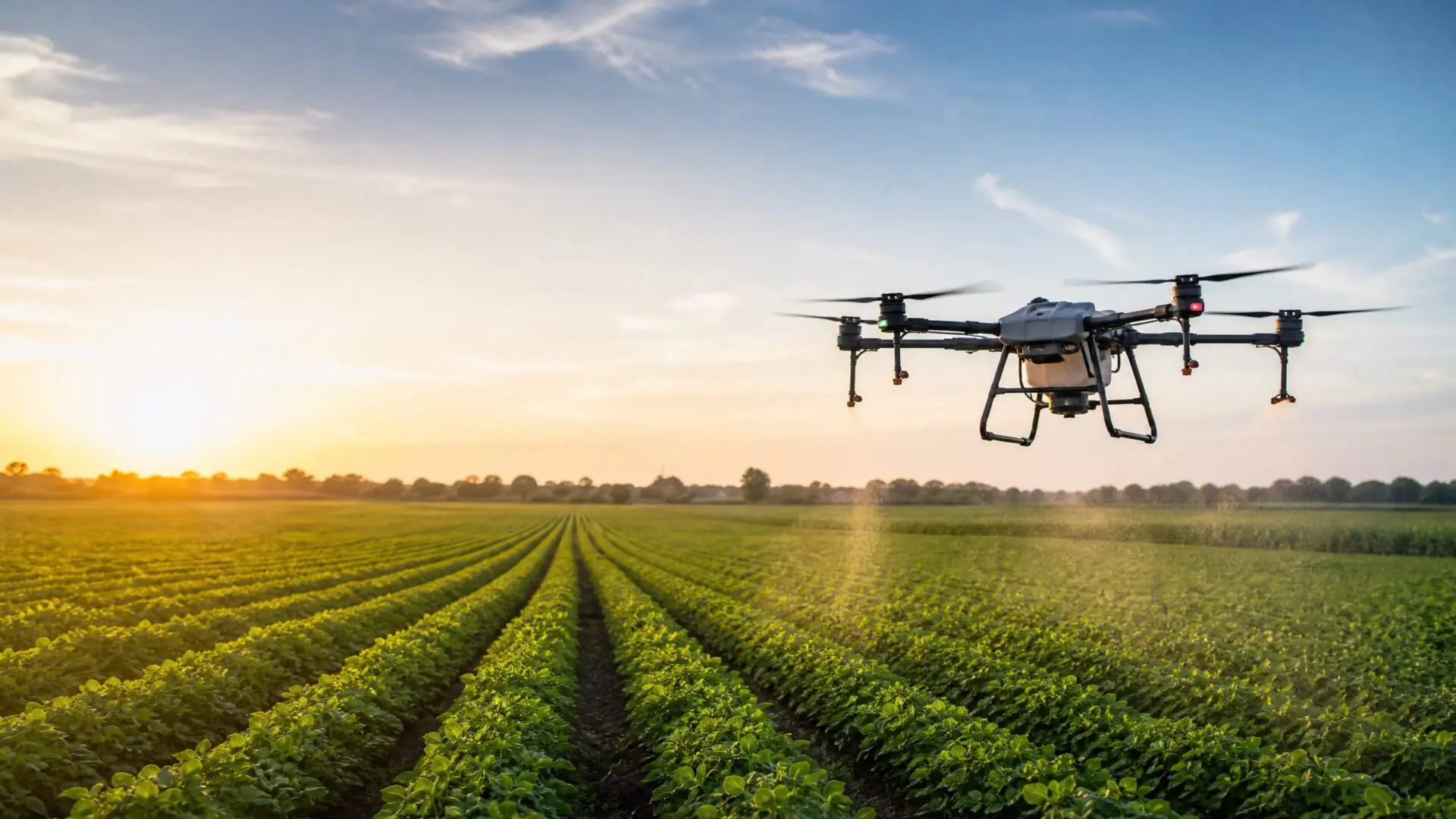
Spraying and spreading are more advanced. They can be valuable when fields are wet, terrain is steep, crops are too tall for ground equipment, or a targeted application is needed. But these jobs also introduce heavier aircraft, field logistics, chemical risk, and additional rules.

| Agricultural drone use | What the drone does | Best fit | Skill level |
|---|---|---|---|
| Crop scouting | Captures visual imagery to spot crop stress, storm damage, drainage problems, or missing stands. | Farmers, crop consultants, and beginner service providers. | Beginner to intermediate. |
| Multispectral crop health | Uses specialized sensors to reveal plant-health patterns normal cameras may miss. | Agronomists, larger farms, and advanced data providers. | Intermediate. |
| Field mapping | Builds maps, elevation models, or field records for drainage, planning, and documentation. | Farms, land managers, and mapping-focused pilots. | Intermediate. |
| Spraying | Applies herbicides, pesticides, fungicides, or other liquid products. | Certified applicators and advanced custom operators. | Advanced. |
| Spreading or seeding | Applies granular fertilizer, cover crop seed, or similar materials. | Farms and specialized service providers. | Advanced. |
| Livestock and farm monitoring | Checks animals, fences, equipment, ponds, buildings, and remote areas. | Ranches and mixed operations. | Beginner to intermediate. |
Croptracker notes that drone imagery can help farmers make agronomic decisions and may be integrated with farm-management software so field health can be reviewed alongside spray records and harvest data.5 That’s the key point: the flight is only part of the job. The real value is the decision the farmer can make after the flight.
How Much Do Agricultural Drones Cost?
Agricultural drone costs vary widely. A basic scouting or mapping setup may cost far less than a full spray-drone operation, while a serious agricultural spraying setup can include the drone, batteries, charger, generator, trailer, tanks, pumps, maintenance, training, insurance, and regulatory work.
The biggest mistake new pilots make is looking only at the drone price. For spray work, the aircraft is just one piece of a working system that includes charging, transport, mixing, cleaning, drift management, documentation, and liability protection.
A March 2025 University of Missouri Extension analysis modeled the economics of owning and operating an Agras T40 drone for spray applications. Under its assumptions, a farmer setup totaled about $56,000, while a custom operator setup with two drones and more support equipment totaled about $94,500.6 The same analysis estimated total application costs of $12.27 per acre for a farmer operation and $7.39 per acre for a custom operator, compared with custom drone spray rates around $16 per acre.6
| Cost category | What’s included | Why it matters |
|---|---|---|
| Aircraft | Camera drone, multispectral drone, spray drone, or spreader drone. | Determines payload, use case, aircraft weight, and rules. |
| Batteries and charging | Batteries, charger, generator, and charging workflow. | Controls downtime and daily production capacity. |
| Field support | Trailer, tanks, pumps, hoses, water handling, and product loading. | Often determines whether spray work is efficient or frustrating. |
| Software | Flight planning, mapping, prescription maps, and farm-management integrations. | Turns imagery or missions into usable decisions. |
| Training and compliance | Part 107, Part 137 path, state applicator rules, manuals, and recordkeeping. | Keeps work legal, insurable, and professional. |
| Insurance and maintenance | Liability coverage, hull coverage, repairs, nozzles, pumps, and wear items. | Protects the operator, the customer, and the equipment. |
The Missouri analysis also found that economics depend heavily on annual acres. Under its assumptions, owning a drone became competitive for a farm operation at around 980 acres per year, while a custom operator needed roughly 3,900 acres per year to reach a target cost near $7.50 per acre.6 Those numbers are not universal, but they’re a useful reminder: spray-drone ROI depends on utilization, not just enthusiasm.
Do You Need a License to Fly Agricultural Drones?
In the United States, agricultural drone work is usually commercial or business-related, so a Part 107 Remote Pilot Certificate is the starting point. If the drone is dispensing or spraying regulated materials, operators may also need Part 137 certification or exemptions, aircraft registration, and state pesticide-applicator credentials.
Part 107 is the FAA rule set for small commercial drone operations. It covers requirements such as remote pilot certification, registration, visual line of sight, airspace authorization, operating limitations, and safe preflight responsibilities.7 If you’re using a drone to support a farm business, provide imagery to a client, scout fields for payment, or market drone services, you should assume Part 107 applies unless the FAA or qualified counsel tells you otherwise.
Spraying is different. The FAA says 14 CFR Part 137 governs aircraft, including drones, used to dispense or spray substances, including agricultural products and certain chemicals.8 Under Part 137, agricultural aircraft operations include dispensing economic poisons, plant-nourishment materials, soil-treatment materials, propagation materials, pest-control materials, and other dispensing activities directly affecting agriculture, horticulture, or forest preservation.9
State rules matter too. If you apply pesticides, herbicides, fungicides, or similar products, you may need a state applicator license or additional approvals. Rules can change and vary by state, so treat this section as a starting point, not legal advice.
What Is the Difference Between Part 107 and Part 137 for Agriculture Drones?
Part 107 is the baseline rule set for most commercial small-drone flights, while Part 137 applies to agricultural aircraft operations that dispense or spray substances for plant nourishment, soil treatment, propagation, pest control, or related agricultural purposes. Many spray-drone operators need to think about both.
If you’re flying a drone over a soybean field to take photos, create a map, or scout damage, Part 107 is usually the main FAA framework. If you’re using a drone to spray fungicide, spread fertilizer, or dispense a regulated agricultural product, Part 137 may enter the picture, along with exemptions and other requirements.
| Rule or requirement | Applies to | Agriculture example | Why pilots care |
|---|---|---|---|
| Part 107 | Commercial small UAS operations. | Crop scouting, field mapping, imagery, and general farm data collection. | It is the starting point for most paid or business-related drone work. |
| Part 137 | Agricultural aircraft dispensing operations. | Spraying fungicide or spreading fertilizer by drone. | It can add certification, exemption, and operational obligations. |
| State applicator rules | Pesticide or chemical application. | Applying herbicide, pesticide, fungicide, or other regulated products. | Requirements vary by state and product label. |
| Aircraft registration | FAA aircraft registration. | Registered small UAS or larger aircraft depending on weight and operation. | Registration must match the aircraft and regulatory path. |
The FAA’s current Part 137 UAS guidance also distinguishes between drones under 55 pounds and drones weighing 55 pounds or more, because the certification and exemption path can differ based on aircraft weight and operation type.8 If you’re considering spray work, build compliance into the business plan before buying the aircraft.
Are Agricultural Drones a Good Business Opportunity for Drone Pilots?
Agricultural drones can be a strong business opportunity, but they’re not a shortcut. The best opportunities come from understanding farm pain points, seasonal timing, safety, regulations, insurance, and deliverables farmers actually value. A drone pilot who can solve a real farm problem is far more valuable than a pilot who only sells flights.
There are three broad entry paths. The first is scouting and documentation, where you help farmers inspect fields, storm damage, irrigation issues, livestock, buildings, or equipment. The second is mapping and data, where you create maps, crop-health layers, elevation insights, or records that support agronomic decisions. The third is spraying and spreading, where the revenue can be attractive but the compliance and operating complexity are much higher.
MSU’s 2025 expert coverage notes that U.S. FAA-registered agricultural drones rose from about 1,000 in January 2024 to around 5,500 by mid-2025, while industry reports may undercount actual U.S. use.3 That kind of growth suggests demand is real, but it also means the market is becoming more professional.
What Kind of Drone Should You Buy for Agriculture?
The right agricultural drone depends on the job. A beginner learning crop scouting does not need the same aircraft as a certified applicator running commercial spray jobs. Start with the deliverable, then choose the aircraft, sensor, software, and compliance path that fit the work.
If you’re new, it’s often smarter to start with a lower-risk aircraft and learn farm operations before purchasing a large spray platform. A camera drone can teach flight planning, image capture, property access, client communication, and basic farm scouting. Spray drones add chemical handling, loading logistics, drift management, application records, and advanced regulatory obligations.

| Goal | Likely drone type | Notes |
|---|---|---|
| Learn farm scouting | Camera drone. | Lower cost and useful for visual inspections, storm checks, and practice. |
| Provide crop-health insights | Multispectral drone. | Requires sensor knowledge and the ability to explain what the data does and does not prove. |
| Build field maps | Mapping-capable drone plus processing software. | Similar to other mapping niches, but farm timing and crop context matter. |
| Spray or spread products | Agricultural spray or spreader drone. | Higher cost, heavier compliance, more logistics, and greater liability. |
How Do You Get Started With Agricultural Drones?
The smartest path is to get legal first, learn safe flight habits, understand the farm problem you’re solving, start with lower-risk scouting or mapping, and only move into spraying after you understand Part 137, state rules, chemical handling, insurance, and field logistics.
Start with Part 107 if you plan to use drones professionally. Drone Launch Academy’s Part 107 training is designed to help pilots understand the FAA knowledge areas and pass the Remote Pilot exam without getting buried in confusing material. From there, practice structured flights: field boundaries, consistent altitude, image overlap, repeatable routes, and clean client deliverables.
Next, talk to farmers, agronomists, crop consultants, and local co-ops. Don’t lead with “I have a drone.” Lead with “What takes too long to inspect?” A pilot who understands the farm’s timing and decision cycle will stand out quickly.
Then build a service ladder. Offer visual scouting first. Add mapping when you can produce clean, useful outputs. Add crop-health or multispectral work only when you can explain the data responsibly. Consider spraying or spreading only after you understand the regulatory pathway, cost model, insurance, product labels, and operational risks.
What Are the Pros and Cons of Agricultural Drones?
Agricultural drones can save time, reduce dangerous manual work, improve field visibility, reduce soil compaction, and support targeted inputs. The tradeoffs are equipment cost, regulatory complexity, battery and field logistics, weather limits, data-interpretation demands, drift risk, and liability.
MSU notes that drones can reduce direct exposure to toxins when they replace manual backpack spraying, but also warns that improper use can spread droplets to neighboring farms, waterways, or bystanders.3 That balance matters. Drones are tools, not magic. In trained hands, they can improve efficiency and safety. In careless hands, they can create expensive problems.
| Pros | Cons |
|---|---|
| Faster scouting and field visibility. | Upfront equipment, software, and training costs. |
| Less soil compaction than tractors because the aircraft flies over the field. | Weather, wind, battery, and payload limits. |
| Access to wet, steep, tall, or hard-to-reach crop areas. | More complex compliance for spraying and dispensing. |
| Potential for targeted spraying, spreading, and efficient inputs. | Drift, chemical exposure, and liability risks if poorly operated. |
| New service-business opportunities in rural markets. | Seasonal demand and narrow application windows. |
What Should New Pilots Know Before Offering Agriculture Drone Services?
New pilots should know that farmers don’t buy “drone flights.” They buy better decisions, saved time, safer application, faster documentation, or measurable operational value. To win clients, you need to understand the crop, timing, deliverable, compliance requirements, and how your work changes a farm decision.
Avoid promising yield increases unless you can prove them. Avoid interpreting agronomic data beyond your expertise. If you’re capturing imagery for a crop consultant, make sure everyone understands who will analyze the data. If you’re flying near workers, roads, livestock, buildings, or chemical operations, write a safety plan and follow it.
Good agricultural drone operators also keep records. Document the date, field, aircraft, batteries, mission settings, weather, airspace checks, deliverables, and unusual events.

FAQ About Agricultural Drones
What drones are used in agriculture?
Agriculture uses camera drones for scouting, multispectral drones for crop-health analysis, mapping drones for field records, and larger spray or spreader drones for applying liquids or granular materials. The best drone depends on the job, crop, field size, budget, and compliance requirements.
How much does a drone cost for agriculture?
A basic scouting setup may be far less expensive than a spray-drone operation, but a serious agricultural spraying setup can cost tens of thousands of dollars once batteries, charging, transport, tanks, pumps, software, insurance, and training are included.
How much do farmers pay for drone spraying?
Rates vary by crop, product, location, acreage, and operator. University of Missouri Extension’s 2025 analysis cited custom drone spray rates around $16 per acre for comparison, while estimating lower per-acre costs for high-utilization owners or custom operators under its assumptions.6
Can I spray crops with a drone under Part 107?
Part 107 may be part of the requirement, but it is not the whole answer for many spray jobs. The FAA states that Part 137 governs aircraft, including drones, used to dispense or spray certain agricultural substances, and operators may need the correct certification or exemption path plus state applicator credentials.8
Are agricultural drones worth it for small farms?
They can be worth it when the drone solves a specific problem, such as checking remote areas, documenting damage, or scouting fields quickly. For spray drones, small farms should compare ownership costs, custom-hire rates, acreage, and seasonal use before buying.
What can you do with an agricultural drone besides spraying?
You can scout crops, map fields, monitor drainage, inspect storm damage, check livestock, review fences and farm assets, document insurance claims, create field records, and collect imagery that supports agronomic decisions.
Bottom Line: Agricultural Drones Are Practical, but Training Comes First
Agricultural drones can be powerful tools for farmers and drone pilots, but the best operators start with training, compliance, and clear deliverables before investing heavily in equipment. For most beginners, Part 107 and farm-relevant flight or mapping skills should come before a spray-drone purchase.
If you want to use drones professionally, build the foundation first. Learn the rules. Practice safe operations. Understand what farmers actually need. Then choose the equipment and service model that fit your local market.
Drone Launch Academy can help with that first step. Whether you’re working toward your Part 107 Remote Pilot Certificate, exploring mapping, or thinking about a future drone business, the goal is the same: fly safely, operate legally, and deliver work that clients can actually use.