Last Updated: April 21, 2026
TL;DR: The Quick Guide to Drone Solar Panel Inspections
Drone solar panel inspections use thermal and RGB cameras to detect hotspots, cracks, and wiring faults in a fraction of the time manual inspections take. A single drone pilot can cover 50 to 100 megawatts (MW) per day, with service costs ranging from $150 to $500 per MW. This comprehensive guide covers the full inspection process, required equipment, typical costs, and how you can start offering this lucrative service to solar farm operators and residential installers.
Solar energy is booming. The United States installed over 32 gigawatts of solar capacity in recent years, and every single one of those panels requires regular inspection to maintain peak efficiency. As solar arrays age, they develop micro-cracks, hotspots, and wiring faults that degrade energy production. Finding these issues manually is slow, dangerous, and expensive.
This is where drone-based thermal and visual inspections come in. By combining high-resolution thermal imaging with automated flight paths, drone pilots can inspect thousands of solar panels in a single afternoon. For commercial drone pilots, this represents one of the fastest-growing and most profitable niches in the industry.
At Drone Launch Academy, we have trained thousands of drone pilots to build successful businesses. In this guide, we will break down exactly how drone solar panel inspections work, what equipment you need, how much you can charge, and how to get started in this high-demand field.
Key Takeaways
- Speed and Efficiency: Drones can inspect solar panels 5 to 10 times faster than manual ground crews, covering up to 100 MW in a single day.
- Thermal Technology: High-resolution thermal cameras (minimum 640×512) are essential for detecting temperature anomalies that indicate failing cells or wiring issues.
- Cost Savings: Solar farm operators can reduce their operations and maintenance (O&M) costs by up to 95% by switching from manual to drone-based inspections.
- Lucrative Pricing: Drone pilots typically charge $150 to $400 for residential inspections and $300 to $500 per MW for utility-scale solar farms.
- Strict Weather Requirements: Accurate thermal data requires clear skies, wind speeds under 15 mph, and solar irradiance above 600 W/m².
What Is a Drone Solar Panel Inspection?
A drone solar panel inspection is an aerial survey that uses thermal imaging and high-resolution cameras mounted on a drone to identify defects, damage, and performance issues across solar arrays—faster and more safely than ground-based methods.
At a high level, the process involves flying a drone in a precise grid pattern over a solar installation while capturing both visual (RGB) and thermal (radiometric) images. The thermal camera is the core technology here. Because failing solar cells generate excess heat instead of electricity, they show up as bright “hotspots” on a thermal image. These temperature differentials reveal faults that are completely invisible to the naked eye.
During an inspection, drones can detect a wide variety of defects. These include individual cell hotspots, cracked glass, delamination, severe soiling or shading, junction box failures, and string-level outages where an entire row of panels goes offline. By identifying these issues early, solar operators can replace defective panels under warranty and restore their system to maximum energy production.
Why Are Drones Better Than Manual Solar Panel Inspections?
Drones inspect solar panels 5 to 10 times faster than manual methods, cover more area with fewer personnel, eliminate fall risks, and capture data that is impossible to gather from the ground.
When inspecting a utility-scale solar farm manually, technicians must walk up and down endless rows of panels, using handheld thermal cameras to check each module. A two-person crew might cover 1 to 2 MW per day. In contrast, a single drone pilot can map 50 to 100 MW in the same timeframe. This massive increase in speed directly translates to lower costs and less downtime for the solar operator.
Safety is another major advantage. Manual inspections often require technicians to work near high-voltage equipment or climb onto steep residential and commercial roofs, introducing significant fall risks. Drones eliminate these hazards entirely by keeping the pilot safely on the ground. Furthermore, the data quality from a drone is vastly superior. Instead of disjointed manual notes, drone software stitches the aerial imagery into comprehensive 3D models, orthomosaics, and thermal maps that provide a complete digital twin of the solar asset.
| Factor | Manual Inspection | Drone Inspection |
|---|---|---|
| Speed | 1 to 2 MW per day | 50 to 100 MW per day |
| Safety | High fall risk, electrical hazards | No personnel on roofs or near panels |
| Typical Cost | $1,500 to $3,000 per site | $150 to $500 per MW |
| Data Quality | Visual only, disjointed notes | Thermal, RGB, GPS-tagged orthomosaics |
| Reporting | Manual data entry | Automated AI-driven defect reports |
| Scalability | Limited by labor availability | Highly scalable across large portfolios |
What Equipment Do You Need for Solar Panel Drone Inspections?
You will need a reliable commercial drone with a thermal camera payload, automated flight planning software, and specialized analysis tools. The most popular professional setup in 2026 is the DJI Matrice 350 RTK equipped with a Zenmuse H20T thermal camera.
The most critical piece of equipment is the thermal camera. For professional solar inspections, you must use a camera with a minimum thermal resolution of 640×512 pixels. Lower resolution cameras (like 256×192) simply do not capture enough detail to accurately diagnose cell-level defects from a safe flying altitude. You also need a high-resolution RGB camera (20 megapixels or higher) to capture visual damage like shattered glass or heavy soiling.
For flight planning, you need software that can execute precise, automated grid patterns with consistent image overlap. Applications like DroneDeploy, Hammer Missions, and DJI Pilot 2 are industry standards. Once the data is captured, you will process it using analysis software such as Raptor Maps, Pix4D, or SkyVisor. These platforms use artificial intelligence to automatically detect anomalies, classify defect severity, and generate comprehensive reports for your clients.
| Equipment Tier | Drone Model | Thermal Resolution | Flight Time | Best Use Case |
|---|---|---|---|---|
| Entry Level | DJI Mavic 3 Enterprise Thermal (~$4,500) | 640×512 | 45 minutes | Residential roofs, small commercial |
| Mid-Range | DJI Matrice 30T (~$10,000) | 640×512 | 41 minutes | Commercial rooftops, small solar farms |
| Professional | DJI Matrice 350 RTK + H20T (~$15,000+) | 640×512 | 55 minutes | Utility-scale solar farms |
How Do You Perform a Drone Solar Panel Inspection?
A drone solar panel inspection follows five distinct steps: pre-flight planning, site surveying, automated flight with data capture, post-processing and analysis, and client reporting.
- Pre-Flight Planning: Before arriving on site, review the solar array layout and check the airspace using LAANC if necessary. Crucially, you must verify the weather. Solar inspections require clear skies (2 oktas or less cloud cover), wind speeds under 15 mph, and solar irradiance above 600 W/m² to ensure the panels are generating enough heat to reveal defects.
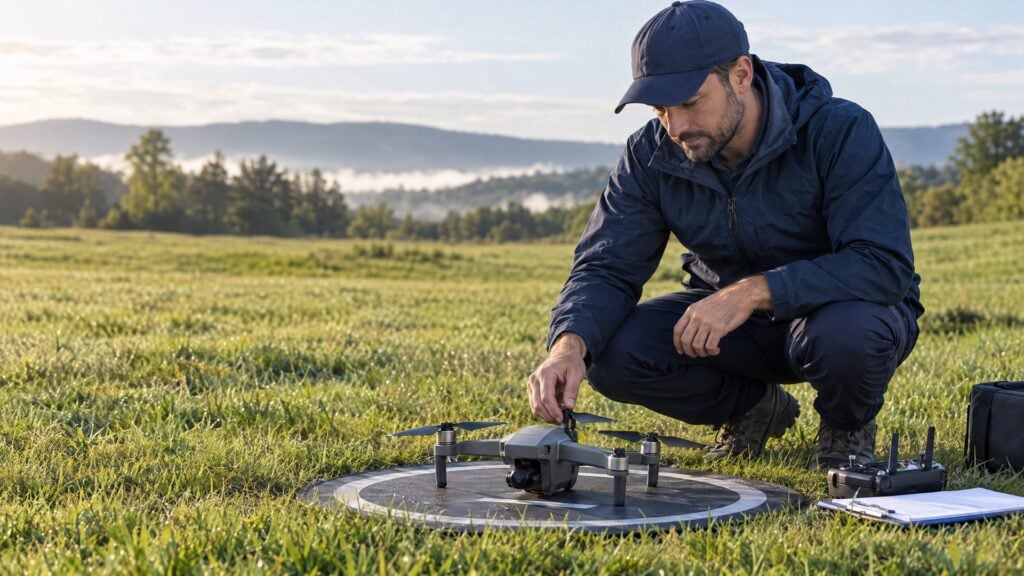
- Site Survey: Upon arrival, walk the perimeter of the site. Identify potential flight obstacles such as power lines, communication towers, or tall trees. Establish a safe launch area and plan emergency landing zones.
- Flight Execution: Set your drone’s altitude—typically 30 to 50 meters above ground level (AGL)—and angle the camera perpendicular to the panels to avoid capturing reflections of the sky. Launch the drone and allow your flight planning software to execute the automated grid pattern, capturing thermal and visual images with 70% to 80% overlap.
- Data Processing: Upload your raw images to your chosen photogrammetry and analysis software. The software will stitch the images together to create a high-resolution orthomosaic and a comprehensive thermal map of the entire site.
- Reporting: The final step is delivering actionable data to your client. Generate a report that highlights defect locations on a site map, provides annotated thermal and visual images of the damage, assigns severity ratings, and offers maintenance recommendations.
At Drone Launch Academy, our specialized courses, such as the Aerial Roof Inspection Pro, walk you through these exact steps with detailed, hands-on guidance. Instructors like Sinuhe and Riley Wiggins, founders of DroneQuote, have created industry-leading methods and protocols for conducting these inspections flawlessly.
How Much Does a Drone Solar Panel Inspection Cost?
Drone solar panel inspection costs range from $150 to $400 for residential systems, $500 to $1,500 for small commercial installations, and $300 to $500 per MW for utility-scale solar farms.
Pricing varies based on several factors, including the size of the site, geographic location, airspace complexity, and the depth of the data analysis required. For example, a client who only wants raw thermal images will pay less than a client who requires a fully annotated, AI-processed diagnostic report mapped against their electrical schematics.
For drone pilots, this pricing structure offers excellent income potential. A pilot inspecting a 10 MW solar farm might charge $4,000 for a job that takes only one or two days to fly and process. For the solar farm operator, the return on investment (ROI) is massive. By identifying and replacing underperforming panels, operators can reclaim lost energy production and reduce their overall maintenance costs by thousands of dollars.
What Are the Most Common Defects Found During Solar Drone Inspections?
The most common defects include hotspots (overheating cells), cracked or broken panels, soiling and debris buildup, junction box failures, string-level outages, and potential induced degradation (PID).
Hotspots are the most frequent issue. When a single solar cell becomes damaged or shaded, it stops producing electricity and instead acts as a resistor, converting power from neighboring cells into heat. On a thermal image, these failing cells glow bright white or red against the cooler, functioning panels. If left unchecked, severe hotspots can cause the glass to shatter or even start a fire.
Other common issues include string outages, where an entire row of panels appears uniformly hot on the thermal map, indicating that a fuse has blown or an inverter has failed. Visual cameras are used simultaneously to detect physical damage, such as panels shattered by hail, heavy dirt accumulation (soiling), or encroaching vegetation that is casting shadows over the array. Finding these issues early allows operators to file warranty claims before they expire.
How Can Drone Pilots Start Offering Solar Inspection Services?
To start offering drone solar inspection services, you need your Part 107 certificate, thermal imaging equipment, training in thermographic analysis, and a plan to reach solar farm operators and installers.
First, you must obtain your FAA Part 107 Remote Pilot Certificate, which is legally required for any commercial drone operation in the United States. Next, invest in a commercial drone equipped with a high-resolution thermal camera, such as the DJI Mavic 3 Enterprise Thermal.
Once you have the gear, you need to understand what you are looking at. Thermographic analysis requires specific knowledge of how temperature differentials indicate electrical faults, guided by standards like IEC 62446-3. To build your portfolio, consider offering discounted or free initial inspections to local residential solar installers. This allows you to practice your workflow and generate sample reports.
Finally, market your services to operations and maintenance (O&M) companies, solar installation firms, and commercial real estate asset managers. Drone Launch Academy’s Drone Business Mastery program covers client acquisition strategies that work specifically for drone service providers, helping you turn your technical skills into a profitable business. As Cody Retlich, one of our Drone Business Mastery instructors, proved by making six figures in his first year of full-time drone work, the financial opportunity is substantial.
Frequently Asked Questions About Drone Solar Panel Inspections
Do you need a Part 107 license for solar panel drone inspections?
Yes. Any commercial drone operation in the United States, including inspecting solar panels for profit or as part of a business, requires an FAA Part 107 Remote Pilot Certificate.
What is the best drone for solar panel inspections?
The DJI Matrice 350 RTK paired with a Zenmuse H20T thermal camera is widely considered the industry standard for utility-scale inspections. For residential and smaller commercial work, the DJI Mavic 3 Enterprise Thermal offers excellent value and portability.
How often should solar panels be inspected by drone?
Most commercial solar farm operators schedule drone inspections annually or semi-annually as part of their preventative maintenance routine. Additionally, new installations should always be inspected during commissioning to establish a baseline and catch immediate installation errors.
Can you inspect residential solar panels with a drone?
Yes. Drone inspections are highly effective for residential panels. They are much safer than sending a technician onto a steep roof and can quickly identify failing microinverters or damaged cells that are degrading the homeowner’s energy production.
What weather conditions are required for solar drone inspections?
To capture accurate thermal data, you need clear skies (2 oktas or less of cloud cover), wind speeds under 15 mph, and solar irradiance above 600 W/m². The panels must be actively generating power and heat for defects to become visible.
How accurate are drone thermal inspections for solar panels?
Modern radiometric thermal cameras with 640×512 resolution can detect temperature differentials as small as 0.05°C. When flown at the correct altitude and angle, they are highly accurate for identifying cell-level defects and electrical faults.
What software is used to analyze solar drone inspection data?
Popular software options include DroneDeploy, Raptor Maps, Pix4D, and SkyVisor. Many of these platforms now feature AI-powered anomaly detection that automatically highlights and categorizes defects based on severity.
How much can you earn doing drone solar panel inspections?
Experienced drone pilots report earning $500 to $2,000+ per inspection job. Large utility-scale contracts can be worth $10,000 or more per project, depending on the megawatt capacity of the site and the depth of the required reporting.
Conclusion
The solar industry is expanding at an unprecedented rate, and with that growth comes an enormous demand for efficient, safe, and accurate inspection services. Manual inspections are simply no longer viable for large-scale solar operations. Drone pilots equipped with thermal imaging technology are uniquely positioned to fill this critical gap in the market.
By understanding the equipment, mastering the flight and analysis processes, and targeting the right clients, you can build a highly profitable niche in drone solar panel inspections.
If you are ready to elevate your drone career, Drone Launch Academy is here to help. David Young, founder of Drone Launch Academy and an FAA-certified Advanced Ground Instructor, along with our team of industry experts, provides the training you need to succeed. Explore our Part 107 Exam Prep, Aerial Roof Inspection Pro, and Drone Business Mastery courses to get started today.
Article By:
Share this post